The Seven Hundred and Seventy-ninth Night
by Unknown
Adapted Version
Once upon a time, there lived a farmer. He had a wife. They also had a clever boy. The clever boy helped them each day.
The wife had a friend. She liked her friend very much. She asked her friend to eat with them. But the friend saw the farmer. The friend ran away fast. The farmer and boy ate the food.
The next day, the farmer went to work. The wife talked to her friend. "I have a bad plan," she said. "I will put powder in their food. They will sleep and never wake up. We stay here." Her friend said, "Do it."
But the clever boy was behind the door. He heard it all. He was very smart.
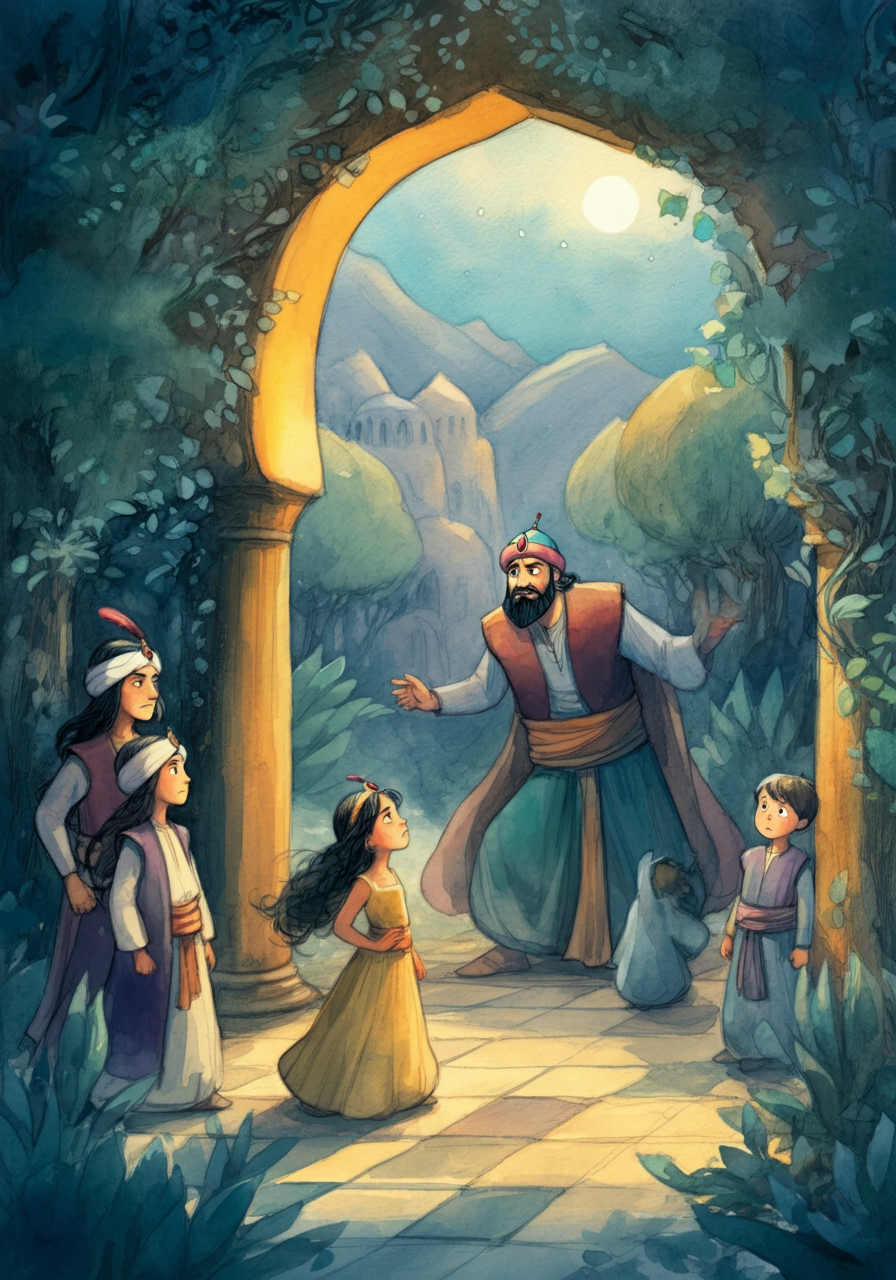
The clever boy had an idea. He put on new clothes. He looked like a street seller. He carried big bags. He called, "Sweet powder!" The wife came out. "Do you have sleeping powder?" she asked. "Yes," said the boy. "Mix it with milk and rice." The wife gave him her shiny anklet. He gave her sugar. It was only sugar!
The wife was happy. She mixed the sugar with milk and rice. She cooked the food. She thought it was sleeping powder. But it was just sweet sugar.
The clever boy ran to the farmer. "The wife has a bad plan," he said. "She put powder in your food. But it is only sugar. Eat the food. Then pretend to sleep. Close your eyes. Do not move."
The farmer came home. He and the boy ate the food. Then they fell down. They closed their eyes. They did not move. They pretended to sleep very deeply.
The wife looked at them. "They are asleep!" she said. She was happy. She called her friend. "Come and see!" she said.
Her friend came to the house. He looked at the farmer and the boy. "They are asleep," he said. They smiled.
Then the farmer opened his eyes! He stood up. The clever boy stood up too. The wife and her friend were very scared.
"You were not kind," said the farmer. "You made a very bad choice." The wife and her friend felt very ashamed. They looked at the ground.
"You must leave my home," said the farmer. "Go away and do not come back." The wife and her friend packed their bags. They walked away from the village. They never came back.
The farmer and the clever boy lived with joy. They lived in peace. They knew it was always best to be kind and honest. Bad choices have bad results.
Original Story
The Seven Hundred and Seventy-ninth Night,
Dunyazad said to her, "Allah upon thee, O my sister, an thou be other than sleepy, finish for us thy tale that we may cut short the watching of this our latter night!" She replied, "With love and good will!" It hath reached me, O auspicious King, the director, the right-guiding, lord of the rede which is benefiting, and of deeds fair-seeming and worthy celebrating, that the more that man cried to the lover "Come," the faster did he run away; so the Fellah returned and said, "He misliketh to come and he hath fled." Hereupon he took seat together with the scald-head and the neighbours to dine off the scones of hand-rubbed grain, and the wife served to them whatso she had made for her lover's eating and she would not touch aught thereof but left it for her spouse and for his servant and for the neighbours. On the following day the Fellah went forth betimes to plough whilst the boy, delaying purposely at home, hid himself behind the door when behold, the lover entered to her, and she said, " 'Tis my desire that we forge a story whereby to slay my husband and Master Scald-head the servant." Quoth he, "How wilt thou slay them?" and quoth she, "I will buy for them poison and make it up in cooked food, so they may devour it together and perish together; after which we will abide, I and thou, making merry, nor shall the dead disturb us any more." He rejoined, "Do what thou willest," and all this whilst the boy stood listening to them behind the door. But as soon as the lover went forth the house, the lad arose and retired; then, donning Jews' garb he shouldered a pair of saddle-bags and went about crying, "Ho! Aloes good for use. Ho! Pepper[473](#linknote-473) good for use. Ho! Kohl good for use. Ho! Tutty good for use!" Now when the woman saw him she came forth the house and hailed him, "Ho thou the Jew!" and said he to her, "Yes, O my lady." Then said she, "Hast thou with thee aught of poison?" and said he, "How, O my lady? Have I not with me poison of the hour?[474](#linknote-474) and whoever shall eat thereof in a mess of sweet milk[475](#linknote-475) and rice and clarified butter shall die within that time." "Do thou take this dinar," continued she, "and give me somewhat of it;" but he rejoined, "I do not trade for moneys, and I will sell it only for ornaments of precious metal." Hereupon she pulled off one of her anklets and handed it to him and he, who had provided himself with half a loaf of Egyptian sugar,[476](#linknote-476) gave her the moiety thereof, saying, "Use it with sweet milk and rice and clarified butter." She took it in high glee, and arising milked the she-buffalo, after which she boiled the loaf-sugar in the milk and then threw it into a sufficiency of the rice and the clarified butter, fancying the while that she was cooking a mortal meal,[477](#linknote-477) and lastly she ladled out the mess into a large platter. Now when it was sunset-time her husband returned from the field and was met about half-way by the boy who told him all that he had overheard and how he had sold her the sugar for one of her anklets, saying, "This be poison." Then he charged him that, as soon as both of them should have swallowed the mess of milk and rice and clarified butter, they fall down and feign dead. So master and servant agreed upon this plan. And when the Fellah entered the hut she served to them the platter which contained their supper, and they ate the whole thereof, she sitting by intent upon their action and expecting their death. But they served her with a sleight; for suddenly the Fellah changed countenance and made as though he waxed ill and faint, and fell upon the ground like one in the last agony, and shortly after the boy rolled upon the floor on similar wise. Whenas she considered them she exclaimed, "May Allah have no mercy upon you; the wretches are dead!" Hereupon she went out and called aloud to her lover, and as he was coming cried, "Hie thee hither and enjoy the sight of these dead ones;" so he hastened up to them, and seeing them stretched upon the door said, "They're dead." Presently quoth she, "We two, I and thou, will now make merry;" and so saying she withdrew with him into another hut, intending at once to sleep together. Hereupon the husband arose and went in to them and smote the lover with a quarter-staff upon the neck and broke in his back bone,[478](#linknote-478) after which he turned to the wicked woman his wife and struck her and split open her head, and left the twain stone dead. And as soon as it was midnight he wrapped them in a single sheet and carried them forth outside the village, and after choosing a place,[479](#linknote-479) dug a hole and thrust them therein. And ever after that same Fellah had rest from his wife, and he bound himself by a strong oath not to interwed with womankind-never no more.[480](#linknote-480) And now (quoth Shahrazad) I will recount to you another tale touching the wiles of women; and thereupon she fell to relating the adventure of
---
Moral of the Story
Betrayal and wickedness will ultimately lead to a grim end.
Characters

The Fellah (Husband) ★ protagonist
A man of sturdy build, accustomed to physical labor in the fields. His skin is likely tanned and weathered from working outdoors under the sun. He possesses a strong, resilient physique.
Attire: Simple, practical clothing suitable for a farmer in a Middle Eastern setting, such as a loose-fitting tunic (thobe) made of coarse linen or cotton, possibly with a simple head covering (keffiyeh) to protect from the sun. Earthy, muted colors.
Wants: To live a peaceful life, to maintain his household, and ultimately, to seek justice and protect himself from his treacherous wife.
Flaw: His initial trust in his wife, which nearly leads to his demise.
Transforms from a trusting husband to a man betrayed, who then cleverly outwits his wife and her lover, ultimately becoming a widower who vows never to marry again.
Hard-working, trusting (initially), observant, decisive, vengeful, cautious.

The Wicked Woman (Wife) ⚔ antagonist
Likely attractive, as she has a lover, but her beauty is superficial, masking a cruel nature. Her build would be typical for a woman of her region and time.
Attire: While living in a rural setting, she would likely possess some modest jewelry, like an anklet. Her everyday attire would be practical but perhaps with a touch more adornment than her husband's, such as a simple dress (thobe) or tunic with a veil or headscarf. Colors might be slightly richer than her husband's, perhaps a deep blue or red.
Wants: To be with her lover, to eliminate her husband and servant, and to live a life of pleasure without consequence.
Flaw: Her overconfidence, her lack of foresight, and her underestimation of her husband and the servant boy.
Begins as a scheming wife, attempts murder, is outwitted, and ultimately meets a violent end at the hands of her husband.
Treacherous, deceitful, cruel, lustful, impatient, overconfident.

The Scald-head (Servant Boy) ◆ supporting
A young boy, likely small for his age, with a distinctive 'scald-head' which implies a condition affecting his scalp or hair, perhaps a form of alopecia or a skin condition. This would make him visually distinct and possibly overlooked or underestimated.
Attire: Simple, worn clothing typical of a servant boy in a rural Middle Eastern household. Perhaps a plain, short-sleeved tunic (galabiya) made of rough cotton in a muted color like grey or beige, and bare feet or simple sandals.
Wants: To survive, to protect his master, and to expose the treachery he witnesses.
Flaw: His youth and physical vulnerability, which he overcomes with his intellect.
Begins as a seemingly minor servant, becomes the key figure in uncovering and thwarting the murder plot, and plays a crucial role in his master's survival and revenge.
Observant, intelligent, resourceful, loyal (to the Fellah), quick-witted, cunning.

The Lover ⚔ antagonist
Likely presented as physically appealing to the wicked woman, perhaps well-built or charming in appearance, contrasting with the hardworking Fellah.
Attire: While not explicitly described, he would likely wear clothing that suggests he is not a laborer, perhaps finer than the Fellah's but still appropriate for a rural setting, such as a clean, well-made tunic and trousers, possibly with a sash or a more decorative head covering.
Wants: To pursue his illicit affair with the wicked woman and to benefit from the removal of her husband.
Flaw: His moral weakness, his willingness to engage in murder, and his overconfidence in the wicked woman's plan.
Begins as a co-conspirator in a murder plot, only to be caught in the act and violently killed by the wronged husband.
Adulterous, opportunistic, complicit, self-serving, easily swayed.
Locations

The Fellah's Hut
A simple, rustic dwelling, likely made of mud brick or rough-hewn timber, characteristic of a rural Egyptian farmer's home. The interior would be sparsely furnished, with a main living area for eating and sleeping, and possibly a smaller, separate hut or partitioned area for privacy. The floor is likely packed earth or simple mats. There is a door that can be hidden behind.
Mood: Initially domestic and seemingly normal, but quickly becomes tense, deceptive, and ultimately violent.
The wife attempts to poison her husband and servant here, and later, the husband kills the wife and her lover here.

Outside the Fellah's Hut/Farmyard
The immediate area surrounding the fellah's hut, likely a dusty farmyard or a small plot of land. It would be typical of a rural Egyptian setting, with sparse vegetation, possibly some domestic animals, and the open fields nearby. The ground is dry earth.
Mood: Initially mundane and agricultural, later becomes a place of public deception and a grim burial site.
The husband goes to plough, the boy disguises himself as a Jew and sells 'poison' to the wife, and later, the wife calls her lover to see the 'dead' husband and servant.

The Fields
The agricultural land where the fellah works, likely irrigated fields for crops like grain or rice, characteristic of the Nile Delta or similar fertile areas in Egypt. It would be open and expansive.
Mood: Laborious and mundane, a place of honest work contrasting with the deceit at home.
The husband goes to plough in the morning and returns at sunset, meeting the boy halfway.

Outside the Village
A secluded, desolate area beyond the inhabited part of the village, chosen for a clandestine burial. It would be uncultivated land, possibly rocky or sandy, away from prying eyes.
Mood: Eerie, desolate, grim, a place of finality.
The husband buries the bodies of his wife and her lover here.
Story DNA
Moral
Betrayal and wickedness will ultimately lead to a grim end.
Plot Summary
A Fellah's unfaithful wife plots with her lover to poison her husband and his loyal servant. The clever servant boy overhears their plan, disguises himself, and sells the wife sugar, claiming it is a deadly poison. The boy then warns his master, and they feign death after eating the 'poisoned' meal. The wife, believing them dead, calls her lover to celebrate, only for the husband to rise and brutally kill both his treacherous wife and her lover, burying them and vowing never to marry again.
Themes
Emotional Arc
betrayal to violent justice
Writing Style
Narrative Elements
Cultural Context
This story is part of 'The Arabian Nights' (One Thousand and One Nights), a collection of Middle Eastern folk tales compiled during the Islamic Golden Age. The framing device of Shahrazad telling stories to King Shahryar is present at the beginning and end.
Plot Beats (13)
- The Fellah's wife tries to invite her lover to dinner, but he flees, so she serves the meal intended for him to her husband and servant.
- The next day, the wife plots with her lover to poison her husband and the servant.
- The servant boy overhears the plot from behind the door.
- The boy disguises himself as a Jewish merchant and sells the wife a piece of Egyptian sugar, claiming it is 'poison of the hour' that works with sweet milk, rice, and clarified butter, in exchange for her anklet.
- The wife, believing it to be poison, prepares a meal of milk, rice, and clarified butter with the sugar for her husband and the servant.
- The servant boy meets the Fellah on his way home and reveals the plot, instructing him and the servant to feign death after eating the meal.
- The Fellah and the servant eat the meal and dramatically collapse, pretending to be dead.
- The wife rejoices, exclaiming they are dead, and calls her lover to come and see.
- The lover arrives, confirms their 'death,' and plans to make merry with the wife.
- The husband arises, enters the hut where the wife and lover are, and kills the lover with a staff.
- The husband then strikes and kills his wife.
- At midnight, the Fellah wraps the bodies in a sheet, carries them outside the village, digs a hole, and buries them.
- The Fellah lives in peace thereafter, vowing never to marry again.