CLEVER ELSIE
by Brothers Grimm

Clever Elsie
They all call her Clever Elsie. But is she really clever? Let us see!
Elsie lives with Mama and Papa. They love her very much. "Elsie is so smart!" says Papa. "Elsie is so clever!" says Mama.
One day, a boy comes. His name is Hans. "I want a clever friend," says Hans. "Is Elsie really clever?"
"Go get juice, Elsie," says Mama. Elsie goes to the kitchen.
In the kitchen, Elsie sees a cup. She sees juice on the table. Then she looks up. A big spoon sits on a shelf. "Oh no!" cries Elsie. "What if the spoon falls? It will fall in my juice! Juice will spill all over!" Elsie sits down. She cries and cries.
Mama comes to the kitchen. "Elsie, why do you cry?" asks Mama. "The big spoon!" cries Elsie. "It will fall in my juice! Juice will spill all over!" "Oh dear! Oh dear!" cries Mama. She sits down. She cries too.
Then Papa comes to the kitchen. "Why do you cry?" asks Papa. "The big spoon!" cries Elsie. "It will fall in my juice!" "Oh no, oh no!" cries Papa. He sits down. He cries too.
Then Hans comes in. He sees Elsie crying. He sees Mama crying. He sees Papa crying. "Why do you all cry?" asks Hans. "The big spoon!" cries Elsie. "It may fall in my juice!" Hans looks at the spoon. It does not move. Hans laughs and laughs. "What a clever Elsie!" he says. "I will be your friend."
Hans says to Elsie one day. "Go pick flowers outside."
Elsie goes to the garden. She eats a snack first. Then she feels sleepy. She lies down. She falls asleep. She forgets the flowers.
Hans looks for Elsie. He finds her in the garden. She is fast asleep. Hans smiles. He puts a jingly band on her arm. Then he goes back inside.
Elsie wakes up. Jingle, jingle! "What is that sound?" says Elsie. She moves her arm. Jingle, jingle! "Who makes that sound?" She does not know.
Elsie runs to the door. She knocks. "Is Elsie home?" she asks.
"Yes! Elsie is here!" says Hans.
"Oh no!" says Elsie. "Then I am not Elsie!" Then Hans opens the door. He points at her arm. "Look!" he says. Elsie sees the band. Jingle, jingle! She laughs. "Oh! I AM Elsie! I was so silly!" Hans laughs too. They both laugh.
Was Elsie clever? What do you think?
Original Story
CLEVER ELSIE
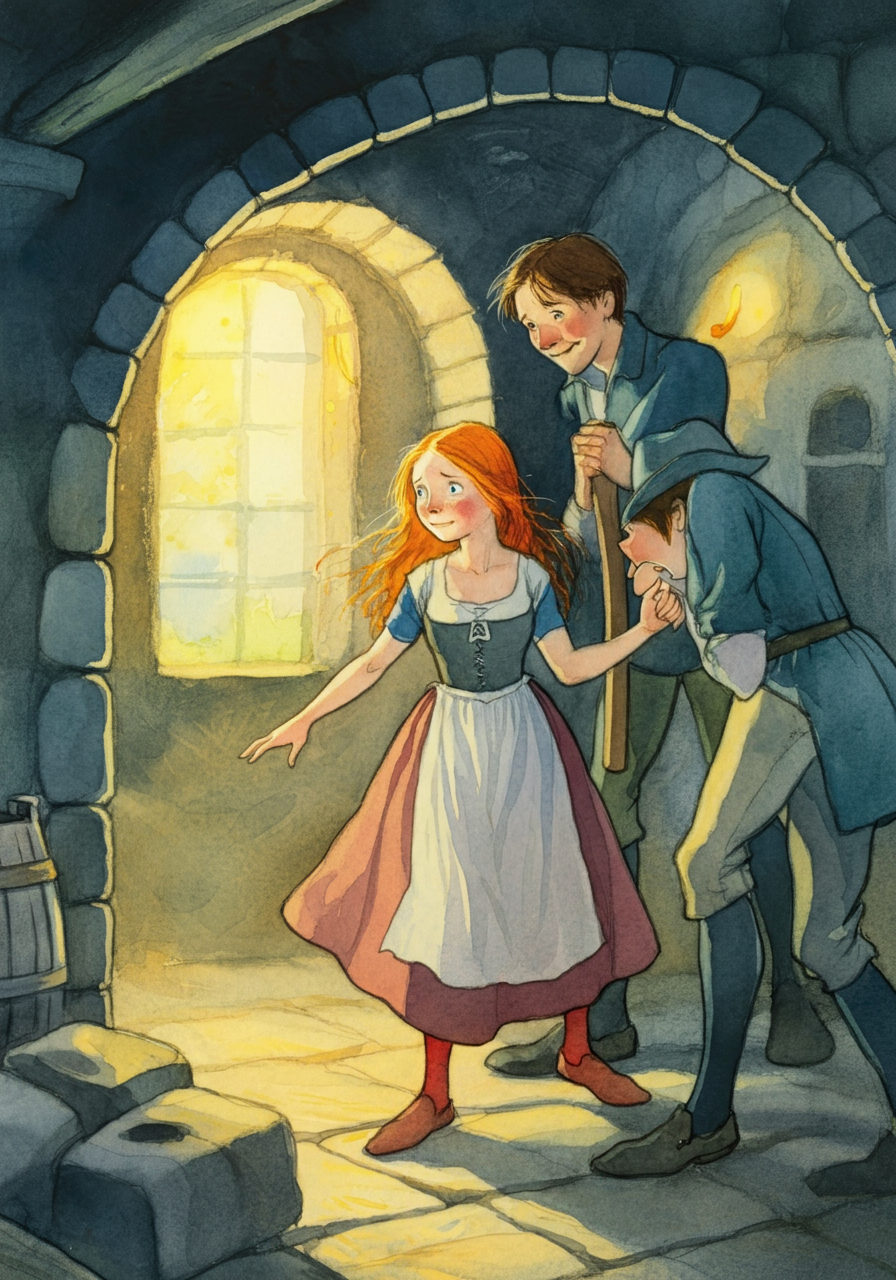
There was once a man who had a daughter who was called Clever Elsie. And when she had grown up her father said, “We will get her married.”
“Yes,” said the mother, “if only any one would come who would have her.”
At length a man came from a distance, and wooed her, who was called Hans. But he made one condition, that Clever Elsie should be really wise.
“Oh,” said the father, “she’s sharp enough.”
And the mother said, “Oh, she can see the wind coming up the street, and hear the flies coughing.”
“Well,” said Hans, “if she is not really wise, I won’t have her.”
When they were sitting at dinner, and had eaten, the mother said, “Elsie, go into the cellar and fetch some beer.”
Then Clever Elsie took the pitcher from the wall, went into the cellar, and tapped the lid briskly as she went that the time might not appear long. When she was below she fetched herself a chair, and set it before the barrel, so that she had no need 118 to stoop, and did not hurt her back or do herself any unexpected injury.
Then she placed the can before her, and turned the tap, and while the beer was running, she would not let her eyes be idle, but looked up at the wall. And after much peering here and there, saw a pickaxe exactly above her, which the masons had left there by mistake.
Then Clever Elsie began to weep and said, “If I get Hans, and we have a child, and he grows big, and we send him into the cellar here to draw beer, then the pickaxe will fall on his head and kill him.” Then she sat and wept and screamed with all the strength of her body, over the misfortune which lay before her.
Those upstairs waited for the drink, but Clever Elsie still did not come. Then the woman said to the servant, “Just go down into the cellar and see where Elsie is.”
The maid went and found her sitting in front of the barrel, screaming loudly.
“Elsie, why do you weep?” asked the maid.
“Ah,” she answered, “have I not reason to weep? If I get Hans, and we have a child, and he grows big, and has to draw beer here, the pickaxe may fall on his head, and kill him.”
Then said the maid, “What a clever Elsie we have!” and sat down beside her and began loudly to weep over the misfortune.
After a while, as the maid did not come back, and those upstairs were thirsty for the beer, the man said to the boy, “Just go down into the cellar and see where Elsie and the girl are.”
The boy went down, and there sat Clever Elsie and the girl 119 both weeping together. Then he asked, “Why are you weeping?”
“Ah,” said Elsie, “have I not reason to weep? If I get Hans, and we have a child, and he grows big, and has to draw beer here, the pickaxe will fall on his head and kill him.”
Then said the boy, “What a clever Elsie we have!” and sat down by her, and likewise began to howl loudly.
Upstairs they waited for the boy, but as he did not return, the man said to the woman, “Just go down into the cellar and see where Elsie is!”
The woman went down, and found all three in the midst of their lamentations, and inquired what was the cause. Then Elsie told her also, that her future child was to be killed by the pickaxe, when it grew big and had to draw beer, and the pickaxe fell down.
Then said the mother likewise, “What a clever Elsie we have!” and sat down and wept with them.
The man upstairs waited a short time, but as his wife did not come back and his thirst grew ever greater, he said, “I must go into the cellar myself and see where Elsie is.”
But when he got into the cellar, and they were all sitting together crying, and he heard the reason, and that Elsie’s child was the cause, and that Elsie might perhaps bring one into the world some day, and that it might be killed by the pickaxe, if it should happen to be sitting beneath it, drawing beer just at the very time when it fell, he cried, “Oh, what a clever Elsie!” and sat down, and likewise wept with them.
The Bridegroom stayed up-stairs alone for a long time; then as no one came back he thought, “They must be waiting for 120 me below. I, too, must go there and see what they are about.”
When he got down, all five of them were sitting screaming and lamenting quite piteously, each outdoing the other.
“What misfortune has happened then?” asked he.
“Ah, dear Hans,” said Elsie, “if we marry each other and have a child, and he is big, and we perhaps send him here to draw something to drink, then the pickaxe which has been left up there might dash his brains out, if it were to fall down, so have we not reason to weep?”
“Come,” said Hans, “more understanding than that is not needed for my household, as you are such a clever Elsie, I will have you,” and he seized her hand, took her upstairs with him, and married her.
After Hans had had her some time, he said, “Wife, I am going out to work and earn money for us. Go into the field and cut the corn, that we may have some bread.”
“Yes, dear Hans, I will do that.”
After Hans had gone away, she cooked herself some good broth, and took it into the field with her. When she came to the field she said to herself, “What shall I do? Shall I shear first, or shall I eat first? Oh, I will eat first.”
Then she emptied her basin of broth, and when she was fully satisfied, she once more said, “What shall I do? Shall I shear first, or shall I sleep first? I will sleep first.” Then she lay down among the corn and fell asleep.
Hans had been at home for a long time, but Elsie did not come. Then said he, “What a clever Elsie I have. She is so industrious, that she does not even come home to eat.”
121 As, however, she still stayed away, and it was evening, Hans went out to see what she had cut. But nothing was cut, and she was lying among the corn, asleep. Then Hans hastened home and brought a fowler’s net with little bells and hung it round about her, and she still went on sleeping. Then he ran home, shut the house-door, and sat down in his chair and worked.
At length, when it was quite dark, Clever Elsie awoke and when she got up there was a jingling all round about her, and the bells rang at each step which she took. Then she was frightened, and became uncertain whether she really was Clever Elsie or not, and said, “Is it I, or is it not I?”
But she knew not what answer to make to this, and stood for a time in doubt. At length she thought, “I will go home and ask if it be I, or if it be not I. They will be sure to know.”
She ran to the door of her own house, but it was shut. Then she knocked at the window and cried, “Hans, is Elsie within?”
“Yes,” answered Hans, “she is within.”
Hereupon she was terrified, and said, “Ah, heavens! Then it is not I,” and went to another door.
But when the people heard the jingling of the bells, they would not open it, and she could get in nowhere. Then she ran out of the village, and no one has seen her since.
<center>* * *</center>
Moral of the Story
Extreme literal-mindedness and a lack of practical sense can lead to absurd and self-defeating outcomes.
Characters

Clever Elsie ★ protagonist
No specific details given, but implied to be marriageable age and able to perform physical labor.
Attire: Simple peasant dress, apron, perhaps a headscarf (typical of a young woman in a rural setting)
Gullible, easily distracted, prone to overthinking

Hans ◆ supporting
No specific details given, but implied to be strong enough to work and provide for a family.
Attire: Simple work clothes, perhaps leather boots (typical of a young man in a rural setting)
Pragmatic, somewhat exasperated, willing to accept Elsie's flaws

Elsie's Mother ◆ supporting
No specific details given, but implied to be matronly.
Attire: Simple, practical dress, apron, headscarf (typical of a woman in a rural setting)
Easily influenced, prone to exaggeration, melodramatic

Elsie's Father ◆ supporting
No specific details given, but implied to be a typical working man.
Attire: Simple work clothes, perhaps a leather vest (typical of a man in a rural setting)
Gullible, easily led, quick to join in the drama

The Maid ○ minor
No specific details given.
Attire: Simple servant's dress, apron
Easily swayed, follows Elsie's lead

The Boy ○ minor
No specific details given.
Attire: Simple tunic and trousers
Impressionable, joins in the weeping
Locations

Beer Cellar
A cool, dim cellar with a beer barrel, a chair, and a pickaxe hanging precariously from the ceiling.
Mood: anxious, foreboding
Elsie envisions her future child's death, causing everyone to weep.

Cornfield
A sunlit field of tall, uncut corn.
Mood: peaceful, lazy
Elsie falls asleep instead of working, leading to Hans' trick with the bells.

Hans' House
A simple house with a door and windows.
Mood: confusing, isolating
Elsie, disoriented by the bells, questions her identity and is denied entry.
Story DNA
Moral
Extreme literal-mindedness and a lack of practical sense can lead to absurd and self-defeating outcomes.
Plot Summary
Clever Elsie, a young woman whose parents boast of her wisdom, is wooed by Hans. When sent to the cellar for beer, Elsie imagines a pickaxe falling on her future child, prompting her entire family to join her in weeping over the hypothetical tragedy. Hans, amused, marries her. Later, Elsie neglects her task of cutting corn to eat and sleep. Hans, finding her asleep, places a bell-laden net around her. Waking to the jingle, Elsie questions her identity, and upon hearing Hans confirm 'Elsie is within' their house, she believes she is not herself and runs away, never to be seen again.
Themes
Emotional Arc
anticipation to absurdity to bewilderment
Writing Style
Narrative Elements
Cultural Context
Fairy tales often served to entertain and sometimes subtly critique societal norms or human foibles. The 'clever' designation is ironic, highlighting a common trope of characters who are anything but.
Plot Beats (14)
- A man wants to marry off his daughter, Clever Elsie, whose parents boast of her wisdom.
- Hans, a suitor, agrees to marry Elsie if she is truly wise.
- Elsie is sent to the cellar to fetch beer.
- In the cellar, Elsie sees a pickaxe and imagines it falling on her future child's head, killing him, and begins to weep loudly.
- One by one, the maid, the boy, the mother, and the father come to the cellar, hear Elsie's imagined tragedy, and join her in weeping.
- Hans comes to the cellar, finds everyone crying over the hypothetical future, and declares Elsie's 'cleverness' sufficient, then marries her.
- Hans sends Elsie to the field to cut corn.
- In the field, Elsie decides to eat first, then sleep, neglecting the corn cutting.
- Hans returns home, finds Elsie still absent, and goes to the field to find her asleep.
- Hans places a fowler's net with bells around Elsie while she sleeps, then returns home and locks the door.
- Elsie wakes up, hears the bells, and becomes confused about her identity.
- Elsie goes to her house, knocks, and asks if 'Elsie is within'.
- Hans replies that 'she is within'.
- Elsie, believing she cannot be herself if 'Elsie is within', runs away from the village and is never seen again.


