THE ELVES AND THE SHOEMAKER
by Brothers Grimm

The Shoemaker and the Little Helpers
There is a shoemaker. He makes shoes. But he is very sad. He has only a little leather left. He is a good man. He works hard every day.
One night, he cuts the leather. He puts it on the table. Then he goes to bed. He sleeps well.
In the morning, he wakes up. He looks at the table. Oh! The shoes are done! They are so beautiful! He picks them up. Not one bad stitch. He smiles and smiles.
A man comes to the shop. He sees the shoes. He likes them very much. He buys the shoes. Now the shoemaker has money. He buys more leather.
Every night, he cuts the leather. Every morning, the shoes are done! He sells the shoes. He buys more leather. He is happy now. He has enough.
One night, the shoemaker says to his wife. "Who helps us?" His wife says, "Let us stay up!" "Let us hide and look."
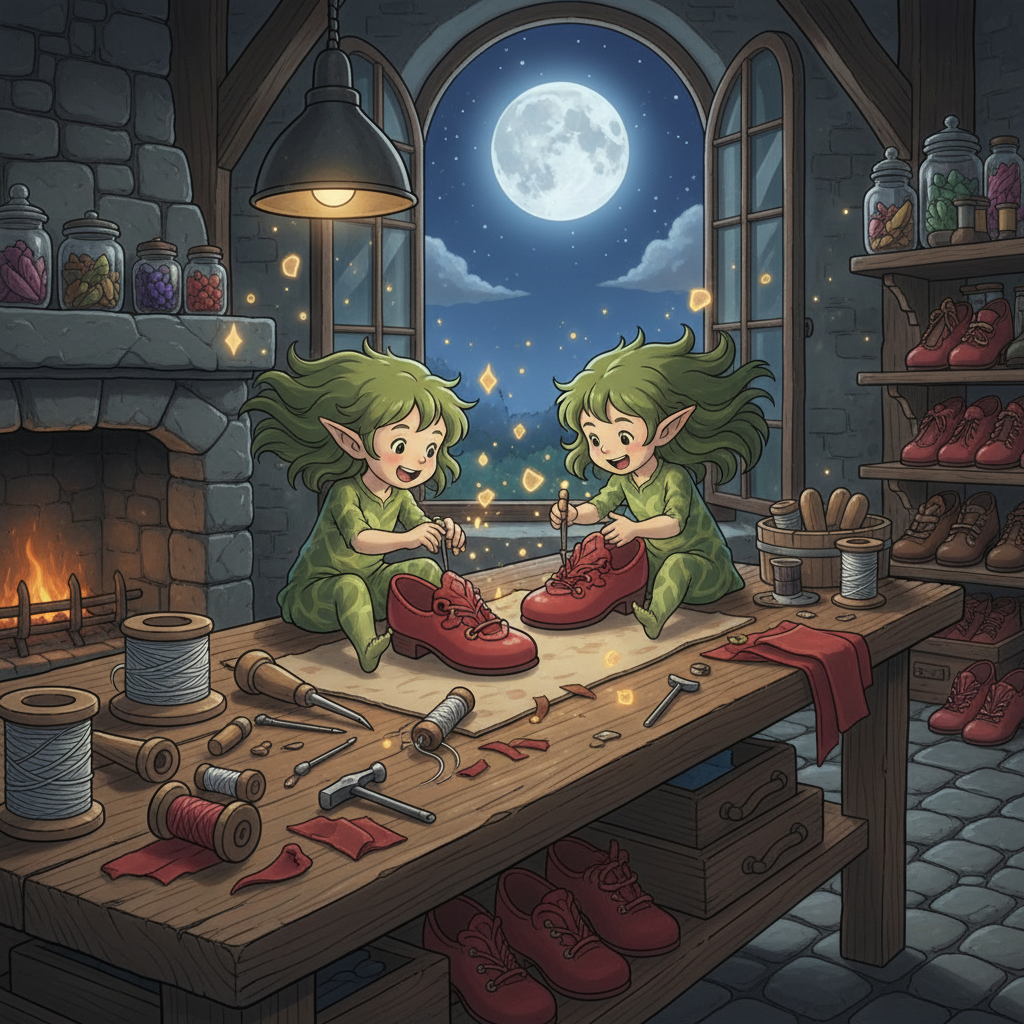
They hide behind the clothes. They wait. It is very late. Then two tiny little men come in! They have no clothes on. They sit at the table. They make the shoes so fast! Their little hands work and work. The shoemaker watches. His wife watches. Then the little men run away.
In the morning, his wife says, "The little men help us." "But they have no clothes!" "They must be cold." "Let us make clothes!"
The shoemaker says, "Yes!" They make tiny shirts. They make tiny pants. The shoemaker makes two tiny pairs of shoes. They put them on the table.
That night, the little men come in. They see the clothes on the table. They are so happy! They put on the tiny shirts. They put on the tiny pants. They put on the tiny shoes. They sing! They dance! They jump over the chairs. They laugh and laugh.
Then they dance out the door. They wave goodbye. They do not come back. But the shoemaker smiles. He is not sad.
The shoemaker and his wife are happy. They have enough. And they always remember the little helpers. They smile.
Original Story
THE ELVES AND THE SHOEMAKER
A shoemaker , by no fault of his own, had become so poor that at last he had nothing left but leather for one pair of shoes. So in the evening, he cut out the shoes which he wished to make the next morning. And as he had a good conscience, he lay down quietly in his bed, commended himself to God, and fell asleep.
In the morning, after he had said his prayers, and was just going to sit down to work, lo! both shoes stood all finished on his table. He was astounded, and did not know what to say. He took the shoes in his hands to examine them closer, and they were so neatly made that there was not one bad stitch in them, just as if they were meant for a masterpiece.
Soon after, a buyer came in, and as the shoes pleased him well, he paid more for them than was customary. And, with the money, the shoemaker was able to purchase leather for two pairs of shoes.
He cut them out at night, and next morning was about to set to work with fresh courage; but he had no need to do so, for, when he got up, they were already made. And buyers also 84 were not wanting, who gave him money enough to buy leather for four pairs of shoes.
The following morning, too, he found the four pairs made. And so it went on constantly, what he cut out in the evening was finished by morning, so that he soon had his honest living again, and at last became a wealthy man.
Now it befell that, one evening not long before Christmas, when the man had been cutting out, he said to his wife, before going to bed, “What think you, if we were to stay up to-night to see who it is that lends us this helping hand?”
The woman liked the idea, and lighted a candle, and then they hid themselves in a corner of the room, behind some clothes which were hanging there, and watched.
When it was midnight, two pretty tiny naked Little Men came, sat down by the shoemaker’s table, took all the work which was cut out before them and began to stitch, sew, and hammer so skilfully and so quickly with their little fingers, that the shoemaker could not turn away his eyes for astonishment. They did not stop until all was done, and stood finished on the table, and then they ran quickly away.
Next morning, the woman said, “The Little Men have made us rich, and we really must show that we are grateful for it. They run about so much, and have nothing on, and must be cold. I’ll tell you what I’ll do. I will make them little shirts, coats, vests, and trousers, and knit both of them a pair of stockings. Do you make them two little pairs of shoes.”
The man said, “I shall be very glad to do it.”
And one night, when everything was ready, they laid their 85 presents, instead of the cut-out work, all together on the table, and then concealed themselves to see how the Little Men would behave.
At midnight they came bounding in, and wanted to get to work at once. But as they did not find any leather cut out, only the pretty little articles of clothing, they were at first astonished, and then they showed intense delight. They dressed themselves with the greatest rapidity, putting the pretty clothes on, and singing:
Then they danced and skipped and leapt over chairs and benches. At last, they danced out of doors. From that time forth they came no more, but as long as the shoemaker lived all went well with him, and all his undertakings prospered.
<center>* * *</center>


Moral of the Story
Kindness and gratitude are rewarded, and good deeds, even when unseen, lead to lasting prosperity.
Characters

Shoemaker ★ protagonist
Thin, worn hands; initially poor and stressed, later prosperous
Attire: Simple, patched leather apron and tunic, later finer clothing reflecting his wealth
Honest, grateful, diligent

Shoemaker's Wife ◆ supporting
Kind face, practical hands
Attire: Simple, practical dress of the period, later finer clothing
Compassionate, thoughtful, observant

Little Men ◆ supporting
Tiny, naked, nimble fingers
Attire: Initially naked, later dressed in miniature shirts, coats, vests, trousers, and stockings
Helpful, joyful, energetic
Locations

Shoemaker's Workshop
A small, humble room with a workbench, tools, and a bed in the corner. Initially sparsely furnished, but gradually accumulating more leather and finished shoes.
Mood: Initially, a feeling of quiet desperation and poverty. Later, a sense of mystery and anticipation, then gratitude and warmth.
The elves secretly craft shoes overnight, transforming the shoemaker's fortune.

Corner Behind Clothes
A hidden space within the workshop, obscured by hanging clothes, allowing the shoemaker and his wife to observe the elves unseen.
Mood: Secretive, suspenseful, and filled with anticipation as the shoemaker and his wife wait to discover the source of their good fortune.
The shoemaker and his wife spy on the elves, discovering their secret benefactors.

Outside the Shoemaker's House
Implied space outside the shoemaker's house where the elves dance away into the night.
Mood: Joyful, free, and magical as the elves celebrate their newfound clothes and freedom.
The elves dance away, never to return, marking a turning point in the shoemaker's life.
Story DNA
Moral
Kindness and gratitude are rewarded, and good deeds, even when unseen, lead to lasting prosperity.
Plot Summary
A poor but honest shoemaker, with only enough leather for one last pair of shoes, finds them miraculously finished each morning. This continues, bringing him great wealth, until he and his wife decide to discover their mysterious helpers. They witness two tiny, naked elves expertly crafting the shoes at night. Out of gratitude, the couple makes clothes and tiny shoes for the elves. The elves joyfully put on their new attire, sing, dance, and then depart forever, leaving the shoemaker and his wife to live a prosperous life.
Themes
Emotional Arc
suffering to triumph
Writing Style
Narrative Elements
Cultural Context
Reflects pre-industrial artisan life and the belief in magical beings that could interact with humans, often rewarding virtue.
Plot Beats (12)
- A poor but honest shoemaker has only enough leather for one last pair of shoes.
- He cuts out the leather for the shoes before going to bed.
- The next morning, he finds the shoes perfectly finished on his table.
- He sells the shoes for a good price, allowing him to buy more leather.
- This pattern repeats: he cuts out leather at night, and by morning, the shoes are finished, leading to his prosperity.
- One evening, near Christmas, the shoemaker suggests to his wife that they stay up to discover their helpers.
- They hide and observe as two tiny, naked elves appear at midnight and swiftly complete the shoemaking.
- The wife, feeling grateful, proposes they make clothes and tiny shoes for the elves.
- The shoemaker agrees, and they prepare the gifts, placing them on the table instead of cut-out leather.
- The elves arrive, find the clothes, express great delight, dress themselves, and sing and dance.
- The elves dance out of the house and are never seen again.
- The shoemaker and his wife continue to prosper for the rest of their lives.


