THE GOOSE-GIRL
by Brothers Grimm

Princess Lily and the Magic Horse
A pretty Princess named Lily lived.
Lily rode to marry a Prince. Maid Clara came. Her magic horse came too. Lily had special red drops. Her mother gave them.
Lily was thirsty. Clara said, "Get your own water!" Lily drank. The red drops fell out. They were lost.
Clara took Lily's clothes. She took the horse. Lily wore old clothes. Clara made her promise. "Do not tell!" Bad things would happen.
They came to the palace. The Prince met Clara. He thought she was Lily. Lily became a goose keeper.
Clara feared the horse. She told men to silence the horse. Its magic head was taken.
Lily asked a man. He put the horse's magic head. It was above the town gate. Lily could speak to it.
Each morning, Lily walked by. She spoke to the horse's head. "Oh, horse, are you there?" The head answered.
Lily combed her gold hair. Conrad saw it. He tried to grab some. Lily made a strong wind. It blew Conrad's hat.
Conrad was angry. He told the King. "Lily vexes me!" he said.
The King watched Lily. He heard her talk to the horse. He saw her magic hair. He saw the wind blow.
The King asked Lily questions. Lily could not speak. She made a promise. The King said, "Tell the stove!"
Lily told the stove her story. She cried and talked. The King listened outside. He heard all she said.
The King called Lily out. She wore royal clothes. She looked pretty. The King told his son. "This is the true Princess!"
At the feast, the King asked Clara. "What for a bad maid?" He told the story. Clara said, "Send them far, far away!"
The King said, "That is for you!" Clara left. Princess Lily married the Prince. They lived happy ever after.
Goodness always wins. Bad people get what they deserve. The truth always comes out.
Original Story
THE GOOSE-GIRL
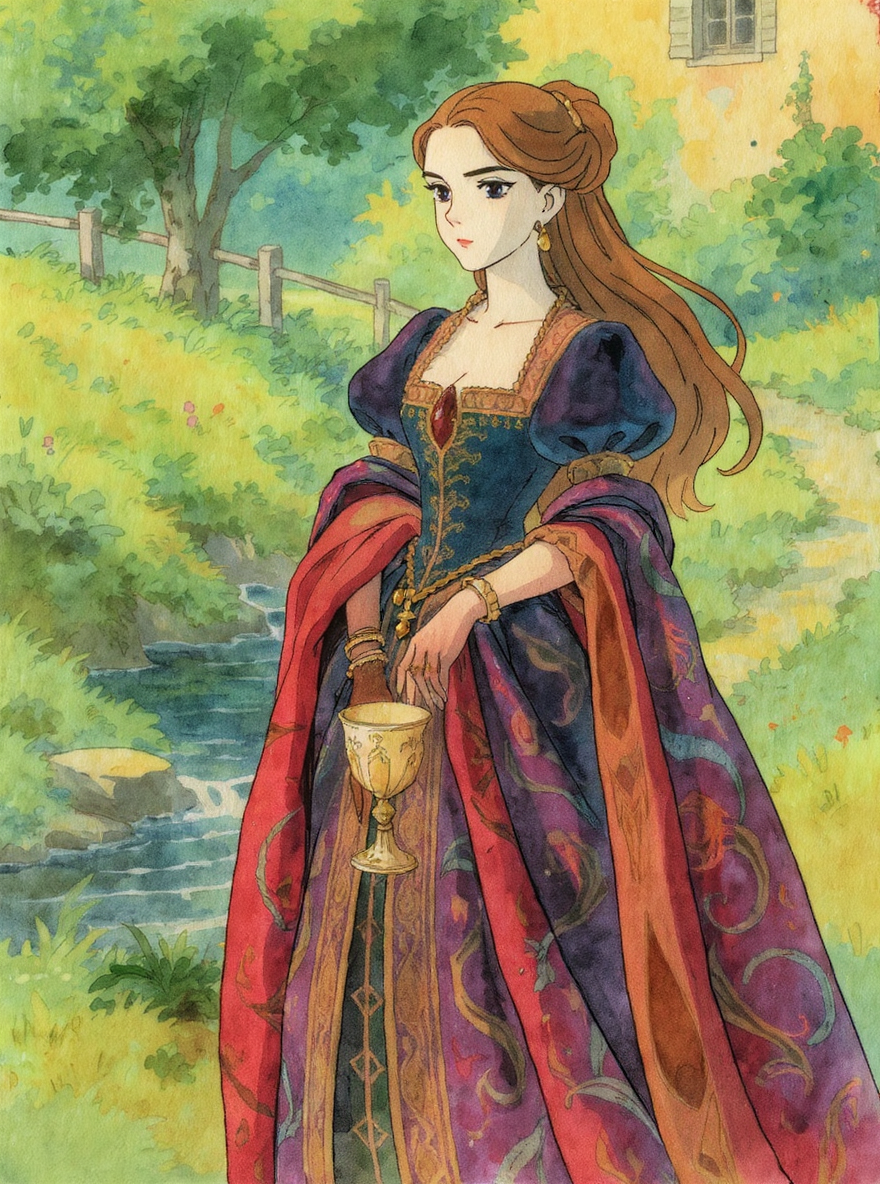
There was once upon a time, an old Queen, whose husband had been dead for many years, and she had a beautiful daughter.
When the Princess grew up, she was betrothed to a Prince who lived very far away. When the time came for her to be married, and she had to journey forth into the distant kingdom, the aged Queen packed up for her many costly vessels of silver and gold, and trinkets, also of gold and silver, and cups and jewels, in short, everything which appertained to a royal dowry, for she loved her child with all her heart.
She likewise sent her maid-in-waiting, who was to ride with her, and hand her over to the Bridegroom. Each had a horse for the journey, but the horse of the King’s Daughter was called Falada, and could speak.
So when the hour of parting had come, the aged mother went into her bedroom, took a small knife and cut her finger with it until it bled. Then she held a white handkerchief to it, into which she let three drops of blood fall.
She gave the handkerchief to her daughter and said, “Dear 241 Child, preserve this carefully. It will be of service to you on your way.”
So they took a sorrowful leave of each other. The Princess put the piece of cloth in her bosom, mounted her horse, and then went away to her Bridegroom.
After she had ridden for a while she felt a burning thirst, and said to her waiting-maid, “Dismount, and take my cup which you have brought with you, and get me some water from the stream, for I should like to drink.”
“If you are thirsty,” said the waiting-maid, “get off your horse yourself, and lie down and drink out of the water. I don’t choose to be your servant.”
So in her great thirst the Princess alighted, bent down over the water in the stream and drank, and was not allowed to drink out of the golden cup. Then she said, “Ah, Heaven!” and the three drops of blood answered:
But the King’s Daughter was humble, said nothing, and mounted her horse again.
She rode some miles further, but the day was warm, the sun scorched her, and she was thirsty once more. When they came to a stream of water, she again cried to her waiting-maid, “Dismount, and give me some water in my golden cup,” for she had long ago forgotten the girl’s ill words.
But the waiting-maid said still more haughtily, “If you wish to drink, drink as you can, I don’t choose to be your maid.”
Then in her great thirst the King’s Daughter alighted, bent 242 over the flowing stream, wept and said, “Ah, Heaven!” and the drops of blood again replied:
And as she was thus drinking and leaning right over the stream, the handkerchief with the three drops of blood fell out of her bosom, and floated away with the water without her observing it, so great was her trouble. The waiting-maid, however, had seen it, and she rejoiced to think that she had now power over the Bride, for since the Princess had lost the drops of blood, she had become weak and powerless.
So now, when she wanted to mount her horse again, the one that was called Falada, the waiting-maid said, “Falada is more suitable for me, and my nag will do for you,” and the Princess had to be content with that.
Then the waiting-maid, with many hard words, bade the Princess exchange her royal apparel for her own shabby clothes; and at length she was compelled to swear by the clear sky above her, that she would not say one word of this to any one at the Royal Court. And if she had not taken this oath she would have been killed on the spot. But Falada saw all this, and observed it well.
The waiting-maid now mounted Falada, and the true Bride the bad horse, and thus they traveled onward, until they entered the royal palace. There were great rejoicings over her arrival, and the Prince sprang forward to meet her, lifted the waiting-maid from her horse, and thought she was his Bride. She was conducted up-stairs, but the real Princess was left standing below.
243 Then the old King looked out of the window and saw her standing in the courtyard, and how dainty and delicate and beautiful she was. He instantly went to the royal apartment, and asked the Bride about the girl she had with her, who was standing down below in the courtyard, and who she was.
“I picked her up on my way for a companion. Give the girl something to work at, that she may not stand idle.”
But the old King had no work for her, and knew of none, so he said, “I have a little boy who tends the geese, she may help him.”
The boy was called Conrad, and the true Bride had to help him to tend the geese.
Soon afterward the false Bride said to the young King, “Dearest Husband, I beg you to do me a favor.”
He answered, “I will do so most willingly.”
“Then send for the butcher, and have the head of the horse on which I rode here, cut off, for it vexed me on the way.” In reality, she was afraid that the horse might tell how she had behaved to the King’s Daughter.
Then she succeeded in making the King promise that it should be done, and the faithful Falada was to die. This came to the ears of the real Princess, and she secretly promised the butcher a piece of gold if he would perform a small service for her. There was a great dark-looking gateway in the town, through which, morning and evening, she had to pass with the geese: would he be so good as to nail up Falada’s head on it, so that she might see him again? The butcher promised to do that, and cut off the head, and nailed it fast beneath the dark gateway.
244 Early in the morning, when she and Conrad drove out their flock beneath this gateway, she said in passing:
Then the head answered:
Then they went still farther out of the town, and drove their geese into the country. And when they had come to the meadow, she sat down and unbound her hair which was like pure gold. Conrad saw it and delighted in its brightness, and wanted to pluck out a few hairs. Then she said:
And there came such a violent wind that it blew Conrad’s hat far away across county, and he was forced to run after it.
When he came back she had finished combing her hair and was putting it up again and he could not get any of it. Then Conrad was angry, and would not speak to her. And thus they watched the geese until the evening, and then they went home.
Next day when they were driving the geese out through the dark gateway, the maiden said:
Falada answered:
245 And she sat down again in the field and began to comb out her hair. Conrad ran and tried to clutch it, so she said in haste:
Then the wind blew, and blew his little hat off his head and far away, and Conrad was forced to run after it. When he came back, her hair had been put up a long time, and he could get none of it. So they looked after their geese till evening came.
But in the evening, after they had got home, Conrad went to the old King, and said, “I won’t tend the geese with that girl any longer!”
“Why not?” inquired the old King.
“Oh, because she vexes me the whole day long.”
Then the old King commanded him to relate what it was that she did to him.
And Conrad said, “In the morning, when we pass beneath the dark gateway with the flock, there is a sorry horse’s head on the wall, and she says to it:
And the head replies:
And Conrad went on to relate what happened on the goose-pasture, and how when there he had to chase his hat.
246 The old King commanded him to drive his flock out again next day, and as soon as morning came, he placed himself behind the dark gateway, and heard how the maiden spoke to the head of Falada. Then he went into the country, and hid himself in the thicket in the meadow. There he soon saw with his own eyes, the goose-girl and the goose-boy bringing their flock, and how after a while she sat down and unplaited her hair, which shone with radiance. And soon she said:
Then came a blast of wind and carried off Conrad’s hat, so that he had to run far away, while the maiden quietly went on combing and plaiting her hair. All of which the King observed.
Then, quite unseen, he went away, and when the goose-girl came home in the evening, he called her aside, and asked why she did all these things.
“I may not tell you that, and I dare not lament my sorrows to any human being, for I have sworn not to do so by the heaven which is above me. If I had not done that, I should have lost my life.”
He urged her and left her no peace, but he could draw nothing from her. Then said he, “If you will not tell me anything, tell your sorrows to the iron stove there,” and he went away.
Then she crept into the iron stove, and began to weep and lament, and emptied her whole heart, and said, “Here am I 247 deserted by the whole world, and yet I am a King’s Daughter, and a false waiting-maid has by force brought me to such a pass, that I have been compelled to put off my royal apparel. She has taken my place with my Bridegroom, and I have to do the mean work of a goose-girl.
The old King was standing outside by the pipe of the stove, and was listening to what she said, and heard it. Then he came back again, and bade her come out of the stove. And royal garments were placed on her, and it was marvelous how beautiful she was! The old King called his son, and revealed to him, that he had got the false Bride who was only a waiting-maid, but that the true one was standing there, as the goose-girl.
The young King rejoiced with all his heart when he saw her beauty and youth, and a great feast was made ready to which all the people and all good friends were invited. At the head of the table sat the Bridegroom with the King’s Daughter at one side of him, and the waiting-maid on the other, but the waiting-maid was blinded, and did not recognize the Princess in her dazzling array.
When they had eaten and drunk, and were merry, the old King asked the waiting-maid as a riddle, what a person deserved who had behaved in such and such a way to her master, and at the same time related the whole story, and asked what sentence such a one merited?
Then the false Bride said, “She deserves no better fate than 248 to be put in a barrel which is studded inside with pointed nails, and two white horses should be harnessed to it, to drag her along through one street after another, till she is dead.”
“It is you,” said the old King, “and you have pronounced your own sentence. Thus shall it be done unto you.”
And when the sentence had been carried out, the young King married his true Bride, and both of them reigned over their kingdom in peace and happiness.
<center>* * *</center>
Moral of the Story
Truth and virtue will ultimately prevail over deceit and wickedness, and those who commit evil will face just retribution.
Characters

The Princess (True Bride) ★ protagonist
Dainty, delicate, and beautiful with a slender build. Her skin is fair, indicative of a European princess, and she possesses a gentle demeanor even in distress.
Attire: Initially, she wears 'royal apparel' befitting a princess on her wedding journey, likely a finely woven gown of silk or brocade in soft colors, possibly adorned with subtle embroidery or jewels. After the switch, she is forced into 'shabby clothes' — simple, coarse peasant garments, perhaps a plain linen shift and a wool apron, likely in muted, earthy tones, worn and ill-fitting.
Wants: To fulfill her duty as a princess and marry her betrothed, and later, to survive her ordeal and maintain her identity.
Flaw: Her humility and obedience, which initially make her vulnerable to the waiting-maid's cruelty and prevent her from speaking out.
She transforms from a sheltered princess into a resilient young woman who endures great suffering and humiliation, ultimately reclaiming her rightful place and proving her worth through her character rather than her status.
Humble, obedient, patient, kind, and resilient. She endures hardship without complaint due to her oath, showing immense self-control and inner strength.

The Waiting-Maid (False Bride) ⚔ antagonist
Her physical appearance is not explicitly detailed, but she is able to convincingly impersonate the Princess, suggesting she is of similar age and general build. Her true nature is reflected in her harsh expressions.
Attire: Initially, she wears 'shabby clothes' of a maid-in-waiting, likely practical but not luxurious. Upon usurping the Princess, she dons the 'royal apparel' of the Princess, which would be costly vessels of silver and gold, and trinkets, also of gold and silver, and cups and jewels, in short, everything which appertains to a royal dowry.
Wants: To usurp the Princess's identity, marry the Prince, and gain royal power and wealth.
Flaw: Her overconfidence and cruelty, which ultimately lead to her downfall when she pronounces her own sentence.
She rises to power through deceit and cruelty, only to be exposed and suffer a gruesome, self-pronounced fate, serving as a cautionary tale against wickedness.
Cruel, arrogant, deceitful, ambitious, and ruthless. She shows no remorse for her actions and is driven by a desire for power and status.

Falada ◆ supporting
A magnificent, noble horse, likely a warhorse or a royal steed, with a strong build and graceful lines. Its coat is not specified, but 'faithful Falada' suggests a dignified appearance.
Attire: Royal tack and bridle, possibly adorned with silver or gold fittings, befitting a princess's mount.
Wants: To serve and protect the true Princess, even in death.
Flaw: Vulnerable to the cruelty of the Waiting-Maid, as it cannot physically defend itself or speak freely to others.
Serves as a loyal companion, is cruelly murdered, but continues to serve the Princess as a talking head, ultimately contributing to the revelation of the truth.
Loyal, wise, and faithful. It observes everything and provides comfort and a voice to the wronged Princess.

The Old King ◆ supporting
An old man, likely with a regal bearing, but also observant and wise. His age is emphasized, suggesting a venerable appearance.
Attire: Royal robes, possibly in rich fabrics like velvet or brocade, with a crown or circlet, indicating his status. His attire would be formal and dignified.
Wants: To ensure justice is served and his son marries the rightful bride, and to maintain order in his kingdom.
Flaw: Initially, he is unaware of the deception, but his wisdom quickly overcomes this.
He serves as the instrument of justice, uncovering the truth through his cleverness and ensuring the rightful order is restored.
Observant, wise, just, and discerning. He is not easily fooled and seeks the truth, showing kindness to the goose-girl.

Conrad ○ minor
A young boy, likely small and energetic, as he is a goose-boy. His appearance would be rustic and unkempt from working outdoors.
Attire: Simple, practical peasant clothes suitable for a goose-boy: a coarse linen tunic, breeches, and perhaps a small, worn cap. Colors would be earthy and muted.
Wants: To tend his geese, and later, to understand the strange behavior of the goose-girl and get a piece of her golden hair.
Flaw: His childish impatience and inability to understand the Princess's plight.
He serves as an unwitting catalyst for the truth to be revealed, observing the Princess's strange actions and reporting them to the King.
Curious, observant, a bit mischievous, and easily frustrated. He is honest and reports what he sees to the King.

The Young King (Prince) ◆ supporting
A handsome young man, befitting a prince, with a strong and noble build. He is described as rejoicing at the Princess's beauty.
Attire: Princely attire, likely fine tunics, breeches, and a cloak made of rich fabrics like silk or brocade, possibly in blue or gold, with subtle embroidery. He would wear a circlet or a simple crown.
Wants: To marry his betrothed and rule his kingdom.
Flaw: His initial gullibility, being easily deceived by the Waiting-Maid's impersonation.
He is initially deceived but ultimately marries his true love and reigns happily, learning the importance of discernment.
Eager, trusting (initially), and ultimately just. He is initially deceived but accepts the truth when revealed.

The Old Queen ○ minor
An aged woman, but still possessing the dignity of a queen. She is a loving mother.
Attire: Regal, somber robes befitting a widowed queen, likely in deep, rich colors like purple or dark blue, made of fine fabrics, with minimal but elegant jewelry.
Wants: To ensure her daughter's safety and happiness on her journey and in her marriage.
Flaw: Her inability to accompany her daughter, leaving her vulnerable to the waiting-maid.
Her role is brief but crucial, setting the stage for the Princess's journey and providing her with a magical safeguard.
Loving, protective, and wise. She foresees potential danger and provides her daughter with a magical safeguard.
Locations

The Roadside Stream
A flowing stream of water by the side of a road, likely in a rural or forested area, where the Princess dismounts to drink.
Mood: desperate, vulnerable, isolated
The Princess is twice denied water from her golden cup by the maid, and the three drops of blood fall into the stream, signifying her loss of protection and power. The maid takes her horse and clothes.

The Royal Palace Courtyard
The open area within the royal palace grounds where guests arrive, featuring a window from which the old King observes. Likely a German-style palace with stone walls and perhaps some timber framing.
Mood: bustling, initially celebratory, later observant
The false bride arrives, greeted as the Princess, while the true Princess is left standing below, observed by the old King.

The Dark Gateway
A large, dark-looking gateway in the town wall, through which the goose-girl and goose-boy pass with their flock morning and evening. Falada's head is nailed beneath it.
Mood: somber, melancholic, watchful
The Princess speaks to Falada's head daily, lamenting her fate, and the old King secretly observes this interaction.

The Goose Pasture/Meadow
An open country meadow where the geese graze. It's a place of natural beauty where the Princess combs her golden hair, causing a magical wind.
Mood: peaceful, magical, revealing
The Princess performs her hair-combing ritual, summoning the wind, which the King observes from a hidden thicket.

The Old King's Royal Apartment/Study
A private room within the royal palace, likely a study or an informal sitting room, where the old King confronts the Princess and later listens to her confession through a stovepipe.
Mood: intimate, interrogative, revealing
The old King questions the Princess, who then confesses her true identity and story to the iron stove, which the King overhears.
Story DNA
Moral
Truth and virtue will ultimately prevail over deceit and wickedness, and those who commit evil will face just retribution.
Plot Summary
A Princess, on her way to marry a distant Prince, is stripped of her identity and royal status by her wicked maid-in-waiting, who forces her to swear an oath of silence and takes her place. Relegated to tending geese, the true Princess secretly laments to the severed head of her loyal talking horse, Falada, and uses magic to protect her golden hair. The old King, alerted by the goose-boy, observes her strange behavior and tricks her into revealing her story to an iron stove, which he overhears. The King then exposes the maid's deception, restores the Princess to her rightful place, and the false bride is punished according to her own judgment, leading to the true couple's happy marriage.
Themes
Emotional Arc
suffering to triumph
Writing Style
Narrative Elements
Cultural Context
This tale, collected by the Brothers Grimm, reflects common themes and social structures of pre-industrial European folklore, including the vulnerability of women, class distinctions, and the belief in magical intervention and poetic justice.
Plot Beats (15)
- A Princess is sent to marry a distant Prince, accompanied by a maid and a talking horse, Falada, and carrying a handkerchief with three drops of her mother's blood for protection.
- During the journey, the Princess becomes thirsty, but her maid refuses to fetch water, forcing the Princess to drink from a stream, causing her to lose the magical blood drops.
- The maid, now empowered, forces the Princess to exchange clothes and horses, and swear an oath of silence under threat of death.
- They arrive at the palace, where the maid is welcomed as the Princess, and the true Princess is assigned the lowly job of goose-girl.
- The false bride, fearing Falada will reveal her deception, orders his head cut off.
- The true Princess secretly asks the butcher to nail Falada's head above the town gate, so she can speak to it daily.
- Each morning, as she passes with the geese, the Princess laments to Falada's head, and it responds.
- In the meadow, the Princess combs her golden hair, and when the goose-boy, Conrad, tries to grab it, she summons a magical wind to blow his hat away.
- Conrad, annoyed by the Princess's actions, complains to the old King.
- The old King secretly observes the Princess's interactions with Falada's head and her magical hair.
- The King confronts the Princess, who, bound by her oath, refuses to speak, but he suggests she confide in an iron stove.
- The Princess pours out her entire story to the stove, unaware the King is listening outside.
- The King brings the Princess out, dresses her in royal attire, and reveals her true identity to his son and the court.
- At the wedding feast, the King asks the false bride to judge a hypothetical case mirroring her own actions, and she pronounces a gruesome sentence upon herself.
- The King declares the sentence is for her, and it is carried out; the true Princess marries the Prince and they live happily ever after.


