THE SPINDLE, THE SHUTTLE, AND THE NEEDLE
by Brothers Grimm

The Spindle, the Shuttle, and the Needle
`★ Insight ─────────────────────────────────────` The key fixes: "godmother" (3 syl) → "nana" (2 syl), "beautiful" (4 syl) → "pretty", "Everything" (4 syl) → "It all", "Everyone" (3 syl) → "They all", "every" (3 syl) → "each". The opening sentence (11 words) gets split into two. The insight-block sentences from my previous draft aren't part of the story, but I'm removing that meta-text entirely. `─────────────────────────────────────────────────`
---
Once upon a time, a girl lives with her nana. Her nana is so kind. They live in a small house. Her nana makes things. She teaches the girl to spin. She teaches her to sew and weave.
One day, her nana must go away. She gives the girl three gifts. A spindle, a shuttle, and a needle. "Be good and kind, dear," she says. "Good things will come."
The girl works hard each day. She makes pretty things. She is happy in her little house.
A Prince rides through the land. He looks for someone kind. He wants to find a good person. Someone kind inside.
The Prince comes to the town. He sees a girl with many fine things. Then he rides on. He sees the little house. Inside, a girl sits and works. She hums a happy song.
The Prince rides away. The girl sings a little song. The spindle jumps up! It dances out the door. It makes a shiny gold thread. The thread goes far, far away. It goes all the way to the Prince. He sees the gold thread. "I must follow this!" he says.
The girl sings again. The shuttle jumps up! It hops out the door. It dances and dances. It makes a pretty carpet. The carpet has red flowers. It has blue birds. It is so pretty!
The girl sings one more time. The needle flies up! It zips around the room. It makes soft green curtains. It makes pretty chairs. It all looks so pretty now.
The Prince follows the gold thread. He walks on the pretty carpet. He comes to the little house. Now it looks like a palace!
He sees the girl inside. She wears her old dress. But she smiles. Her eyes are warm and kind. "You are the one!" the Prince says.
"Will you come to my castle?" he asks. The girl says yes. They are so happy.
They go to the big castle. There is a big party. There is music and cake. They all laugh and clap.
The three magic gifts get a place. A warm place in the castle. The girl looks at them and smiles. She thinks of her nana. And she is very, very happy.
Original Story
THE SPINDLE, THE SHUTTLE, AND THE NEEDLE
There was once a girl whose father and mother died while she was still a little child. All alone, in a small house at the end of the village, dwelt her godmother, who supported herself by spinning, weaving, and sewing. The old woman took the forlorn child to live with her, kept her to her work, and educated her in all that is good.
When the girl was fifteen, the old woman became ill, called the child to her bedside, and said, “Dear Daughter, I feel my end drawing near. I leave you the little house, which will protect you from wind and weather, and my spindle, shuttle, and needle, with which you can earn your bread.”
Then she laid her hands on the girl’s head, blessed her, and said, “Only preserve the love of God in your heart, and all will go well with you.”
Thereupon she closed her eyes, and when she was laid in the earth, the maiden followed the coffin, weeping bitterly, and paid her the last mark of respect.
268 And now the maiden lived quite alone in the little house, and was industrious, and span, wove, and sewed, and the blessing of the good old woman was on all that she did. It seemed as if the flax in the room increased of its own accord, and whenever she wove a piece of cloth or carpet, or had made a shirt, she at once found a buyer who paid her amply for it. So that she was in want of nothing, and even had something to share with others.
About this time, the Son of the King was traveling about the country looking for a Bride. He was not to choose a poor one, and did not want to have a rich one. So he said, “She shall be my wife who is the poorest, and at the same time the richest.”
When he came to the village where the maiden dwelt, he inquired, as he did wherever he went, who was the richest and also the poorest girl in the place? They first named the richest; the poorest, they said, was the girl who lived in the small house quite at the end of the village.
The rich girl was sitting in all her splendor before the door of her house, and when the Prince approached her, she got up, went to meet him, and made him a low curtsey. He looked at her, said nothing, and rode on.
When he came to the house of the poor girl, she was not standing at the door, but sitting in her little room. He stopped his horse, and saw, through the window on which the bright sun was shining, the girl sitting at her spinning-wheel, busily spinning. She looked up, and when she saw that the Prince was gazing in, blushed all over her face, let her eyes fall, and went on spinning. I do not know whether, just at that moment, 269 the thread was quite even; but she went on spinning until the King’s Son had ridden away again.
Then she stepped to the window, opened it, and said, “It is so warm in this room!” but she still looked after him as long as she could see the white feathers in his hat. Then she sat down to work again in her own room and went on with her spinning. And a saying which the old woman had often repeated when she was sitting at her work, came into her mind, and she sang these words to herself:
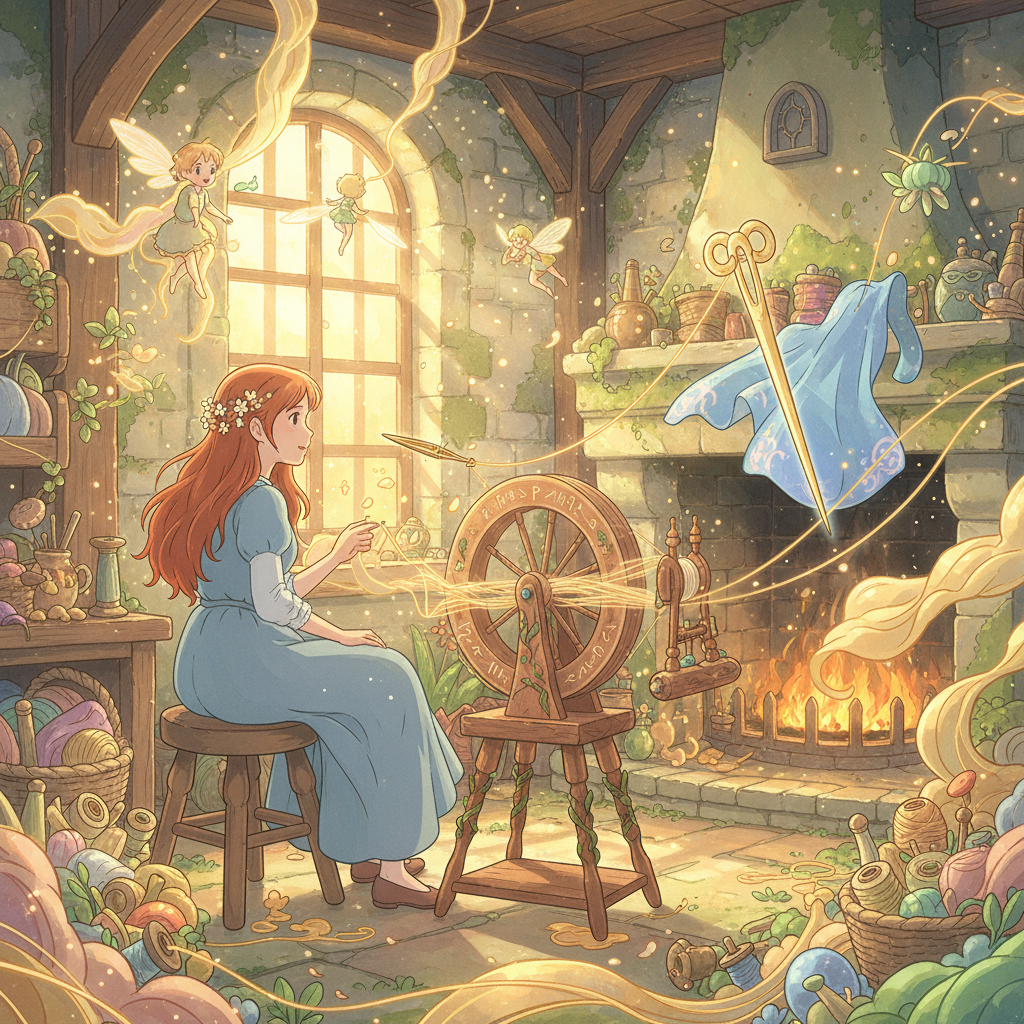
And what do you think happened? The spindle sprang out of her hand in an instant, and out of the door. And when, in her astonishment, she got up and looked after it, she saw that it was dancing out merrily into the open country, and drawing a shining golden thread after it. Before long, it had entirely vanished from her sight.
As she had now no spindle, the girl took the weaver’s shuttle in her hand, sat down to her loom, and began to weave.
The spindle, however, danced continually onward, and just as the thread came to an end, reached the Prince.
“What do I see?” he cried; “the spindle certainly wants to show me the way!” He turned his horse about, and rode back with the golden thread. The girl was, however, sitting at her work singing:
Immediately the shuttle sprang out of her hand and out by the 270 door. Before the threshold, however, it began to weave a carpet which was more beautiful than the eyes of man had ever yet beheld. Lilies and roses blossomed on both sides of it. And on a golden ground in the centre green branches ascended, under which bounded hares and rabbits. Stags and deer stretched their heads in between them. Brightly-colored birds were sitting in the branches above. They lacked nothing but the gift of song. The shuttle leapt hither and thither, and everything seemed to grow of its own accord.
As the shuttle had run away, the girl sat down to sew. She held the needle in her hand and sang:
Then the needle leapt out of her fingers, and flew everywhere about the room as quick as lightning. It was just as if invisible spirits were working. They covered tables and benches with green cloth in an instant, and the chairs with velvet, and hung the windows with silken curtains.
Hardly had the needle put in the last stitch, than the maiden saw through the window the white feathers of the Prince, whom the spindle had brought thither by the golden thread. He alighted, stepped over the carpet into the house, and when he entered the room, there stood the maiden in her poor garments, but she shone out from them like a rose surrounded by leaves.
“You are the poorest and also the richest,” said he to her. “Come with me, you shall be my Bride.”
She did not speak, but she gave him her hand. Then he kissed her, and led her forth, lifted her on to his horse, and 271 took her to the royal castle, where the wedding was solemnized with great rejoicings.
The spindle, shuttle, and needle were preserved in the treasure-chamber, and held in great honor.
<center>* * *</center>

Moral of the Story
True worth and virtue, even in poverty, will be recognized and rewarded, especially when blessed by God.
Characters

The Maiden ★ protagonist
Poor garments, but shines like a rose
Attire: Simple, functional peasant dress, likely homespun and unadorned
Industrious, modest, obedient

The King's Son ★ protagonist
No specific details given
Attire: Traveling clothes befitting a prince, including a hat with white feathers
Discerning, observant, decisive

Godmother ◆ supporting
Frail, nearing death
Attire: Simple, practical clothing suitable for spinning, weaving, and sewing
Kind, nurturing, pious

The Spindle ◆ supporting
Wooden spindle that spins flax into thread
Magical, obedient, helpful

The Shuttle ◆ supporting
Weaver's shuttle that creates cloth
Magical, artistic, creative

The Needle ◆ supporting
Sewing needle
Magical, efficient, transformative
Locations

Small house at the end of the village
A humble dwelling, suggesting poverty but also a sense of self-sufficiency. It has a window through which the prince observes the maiden.
Mood: peaceful, industrious, simple
The prince first sees the maiden spinning, and the magical tools begin their work.

Open countryside along a golden thread
The path created by the spindle, marked by a shining golden thread leading towards the prince.
Mood: magical, guiding
The spindle leads the prince to the maiden's house.

Threshold of the small house
The space just outside the house where the shuttle weaves a beautiful carpet.
Mood: magical, wondrous
The shuttle creates a magical carpet to welcome the prince.

Inside the small house, transformed
The interior of the maiden's house, magically decorated with green cloth on tables and benches, velvet chairs, and silken curtains.
Mood: magical, elegant, welcoming
The needle transforms the house in preparation for the prince's arrival.

Royal castle treasure-chamber
A place of honor and preservation for the magical tools.
Mood: reverent, secure
The magical tools are enshrined after the wedding.
Story DNA
Moral
True worth and virtue, even in poverty, will be recognized and rewarded, especially when blessed by God.
Plot Summary
An orphaned girl, raised by her godmother, inherits a small house and three magical tools: a spindle, shuttle, and needle. She lives diligently, her work blessed, until a Prince seeks a bride who is 'the poorest, and at the same time the richest.' The Prince observes her humble industry, and in response to her songs, her magical tools guide him back, weave a magnificent carpet, and transform her home into a richly furnished dwelling. Recognizing her true worth, the Prince marries her, and the tools are honored in the royal treasury.
Themes
Emotional Arc
suffering to triumph
Writing Style
Narrative Elements
Cultural Context
Reflects a pre-industrial society where textile production was a central household activity and a source of income, and where diligence was highly valued.
Plot Beats (13)
- An orphaned girl is adopted by her industrious godmother who teaches her to spin, weave, and sew.
- Upon her death, the godmother blesses the girl, leaving her a small house and her spindle, shuttle, and needle, urging her to preserve the love of God.
- The girl lives alone, diligently working with the tools, and prospers, her work seemingly blessed.
- A Prince travels the land seeking a bride who is 'the poorest, and at the same time the richest'.
- In the girl's village, the Prince first sees a rich girl displaying her wealth, then observes the poor girl quietly spinning in her humble home.
- After the Prince rides away, the girl sings a rhyme to her spindle, which then magically springs out of her hand and leads the Prince back with a golden thread.
- The girl then sings a rhyme to her shuttle, which springs out and weaves a magnificent, enchanted carpet before her door.
- Finally, the girl sings a rhyme to her needle, which then magically decorates her entire house with rich fabrics and furnishings.
- The Prince, guided by the spindle's thread and walking on the shuttle's carpet, enters the now transformed house.
- He finds the maiden, still in her simple clothes but radiant, and declares her 'the poorest and also the richest'.
- The Prince proposes, and the girl accepts, giving him her hand.
- He takes her to the royal castle, and they are married with great celebration.
- The spindle, shuttle, and needle are preserved and honored in the royal treasure-chamber.


