THE THREE BROTHERS
by Brothers Grimm

The Three Clever Brothers
Once upon a time, there was a father. He had three sons. They all loved one old house. It was small but warm. Father loved them all the same. But each son wanted the house.
One day, Father had an idea. "Go out and learn," he said. "Learn one new thing. Then come back home. Show me your best trick. The best one wins!" The sons smiled. They were happy.
The first brother learned to make things. He used a hammer and hot metal. The second brother learned to cut hair. He used sharp scissors. The third brother learned the sword. He was brave and quick.
Each brother found a good teacher. They worked very hard. They did it each day. They all got very, very good.
Time passed. The three brothers came home. They were big and strong now. Father was so glad. "Show me," he said.
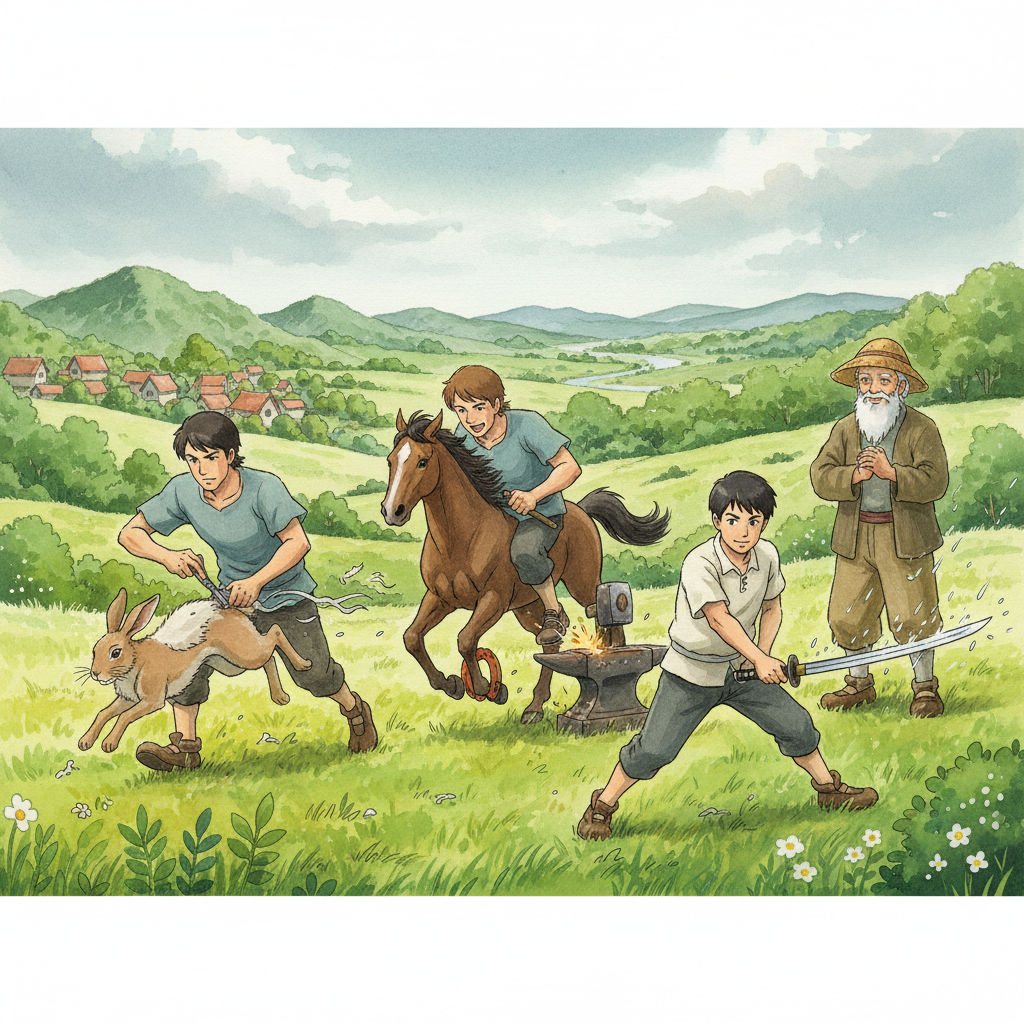
A rabbit ran across the field. It ran very, very fast. The second brother ran too. He took out his scissors. Snip, snip, snip! He cut the rabbit's hair just right. He did not hurt the rabbit! It did not stop running! "Very good!" said Father.
Then a horse ran by. It ran very fast too. The first brother ran after it. He had his hammer ready. He put new shoes on the horse. The horse did not stop running! "Very good!" said Father.
Then it started to rain. The rain came down hard. It rained and rained and rained. The third brother took out his sword. He moved it so fast! He moved it over his head. Not one drop touched him! He was all dry! "So good!" said Father.
Father smiled at his sons. "The third brother wins," he said. "He did the best trick. The house goes to him!"
But the brothers loved each other. They did not want to live apart. "Let us all stay here," they said. Father smiled. All three stayed in the house.
They helped each other each day. They laughed and played and worked. They were so happy at home. And they lived happy ever after. All in their little house.
Original Story
THE THREE BROTHERS
There was once a man who had three sons, and nothing else in the world but the house in which he lived. Now each of the sons wished to have the house after his father’s death; but the father loved them all alike, and did not know what to do. He did not wish to sell the house, because it had belonged to his forefathers, else he might have divided the money amongst them.
At last a plan came into his head, and he said to his sons, “Go into the world, and try each of you to learn a trade. When you all come back, he who makes the best masterpiece shall have the house.”
The sons were well content with this, and the eldest determined to be a blacksmith, the second a barber, and the third a fencing-master. They fixed a time when they should all come home again, and then each went his way.
It chanced that they all found skilful masters, who taught them their trades well. The blacksmith had to shoe the King’s horses, and he thought to himself, “The house is mine, without doubt.” The barber shaved only great people, and he too already 87 looked upon the house as his own. The fencing-master got many a blow, but he only bit his lip, and let nothing vex him; “for,” said he to himself, “if you are afraid of a blow, you’ll never win the house.”
When the appointed time had gone by, the three brothers came back home to their father. But they did not know how to find the best opportunity for showing their skill, so they sat down and consulted together.
As they were sitting thus, all at once a hare came running across the field. “Ah, ha, just in time!” said the barber. So he took his basin and soap, and lathered away until the hare came up. Then he soaped and shaved off the hare’s whiskers whilst he was running at the top of his speed, and did not even cut his skin or injure a hair on his body.
“Well done!” said the old man, “your brothers will have to exert themselves wonderfully, or the house will be yours.”
Soon after, up came a nobleman in his coach, dashing along at full speed. “Now you shall see what I can do, Father,” said the blacksmith. So away he ran after the coach, took all four shoes off the feet of one of the horses whilst he was galloping, and put on four new shoes without stopping him.
“You are a fine fellow, and as clever as your brother,” said his father. “I do not know to which I ought to give the house.”
Then the third son said, “Father, let me have my turn, if you please.” And, as it was beginning to rain, he drew his sword, and flourished it backward and forward above his head so fast that not a drop fell upon him. It rained still harder and harder, till at last it came down in torrents. But he only flourished 88 his sword faster and faster, and remained as dry as if he were sitting in a house.
When his father saw this he was amazed, and said, “This is the masterpiece, the house is yours!”
His brothers were satisfied with this, as was agreed before-hand. And, as they loved one another very much, they all three stayed together in the house, followed their trades, and, as they had learnt them so well and were so clever, they earned a great deal of money.
Thus they lived together Happily, until they grew old. And at last, when one of them fell sick and died, the two others grieved so sorely about it that they also fell ill, and soon after died. And because they had been so clever, and had loved one another so much, they were all laid in the same grave.
<center>* * *</center>
Moral of the Story
True mastery and familial love can lead to shared prosperity and happiness, even in competition.
Characters

The Father ◆ supporting
Old, but loved by his sons
Attire: Simple, rustic clothing appropriate for a homeowner of modest means
Fair, loving, resourceful

Eldest Brother ◆ supporting
Strong, muscular build from blacksmithing
Attire: Leather apron, sturdy boots, blacksmith's attire
Confident, skilled, competitive

Middle Brother ◆ supporting
Nimble fingers, clean-shaven
Attire: Barber's smock, carrying shaving tools
Precise, meticulous, proud

Youngest Brother ★ protagonist
Agile, quick reflexes
Attire: Fencing attire, including a padded jacket and mask
Determined, skillful, stoic
Locations

The Father's House
A house that has belonged to the family for generations, implying age and perhaps a sense of history or tradition.
Mood: Sentimental, familial, a place of origin and inheritance.
The father proposes the contest to determine who inherits the house; the brothers return after their apprenticeships.

Open Field
A field outside the house, large enough for a hare to run across and a nobleman's coach to travel through.
Mood: Neutral, a testing ground, a place for skills to be displayed.
The brothers demonstrate their skills: shaving the hare, shoeing the horse, and deflecting the rain.

The Shared Grave
A single grave where all three brothers are buried together.
Mood: Sorrowful, peaceful, a final resting place symbolizing their unity and love.
The brothers are buried together after dying of grief, signifying their strong bond.
Story DNA
Moral
True mastery and familial love can lead to shared prosperity and happiness, even in competition.
Plot Summary
A father with three sons, owning only his house, challenges them to learn trades and present a masterpiece to decide who inherits it. The sons become a blacksmith, a barber, and a fencing-master, each excelling in their craft. They demonstrate their extraordinary skills: the barber shaves a running hare, the blacksmith shoes a galloping horse, and the fencing-master stays dry in a downpour by flourishing his sword. The father declares the fencing-master's feat the best, but the brothers, out of love, decide to live together, combining their earnings and living happily until they die together in old age.
Themes
Emotional Arc
uncertainty to shared triumph and contentment
Writing Style
Narrative Elements
Cultural Context
Reflects a pre-industrial society where skilled trades were highly valued and often passed down through families. The concept of a 'masterpiece' was common in guilds for proving one's skill.
Plot Beats (13)
- An old man has three sons and only a house, which all sons want.
- The father, unable to choose, tasks his sons to learn a trade and present a masterpiece to win the house.
- The sons agree, choosing blacksmith, barber, and fencing-master, and depart to learn their crafts.
- Each son finds a skilled master and excels in his chosen trade.
- Upon returning home, the brothers discuss how to best showcase their skills.
- A hare runs by, and the barber expertly shaves its whiskers while it's running, impressing the father.
- A nobleman's coach passes, and the blacksmith skillfully removes and replaces all four horseshoes on a galloping horse.
- The fencing-master, as it begins to rain, flourishes his sword so fast that he remains completely dry in a downpour.
- The father declares the fencing-master's feat the best masterpiece, awarding him the house.
- The brothers, content with the decision and their mutual love, decide to live together in the house.
- They combine their earnings from their trades and live happily and prosperously together until old age.
- When one brother dies, the others grieve so deeply they also fall ill and die soon after.
- All three brothers are laid in the same grave due to their cleverness and strong bond.


