THE WHITE SNAKE
by Brothers Grimm

The Kind Servant and the Magic Snake
Here's the revised story with the targeted fixes applied:
Once upon a time, there was a King. He had a big secret. Each day he ate special magic food. It was on a pretty plate. No one knew about it.
A kind boy helped the King. One day the boy wanted to taste it. He tasted the magic food. Oh! A magic thing happened. He could hear birds and bugs talk! He heard birds sing words. He heard bugs say things.
The Queen lost her pretty ring. Some people said the boy took it. But he did not take it. He felt very sad.
The boy walked by a pond. He heard ducks talking. "I found a shiny ring!" said one duck. The duck gave the ring back. "Thank you!" said the boy. "We will remember you!" said the ducks. They all were happy.
The King smiled at the boy. "Go see the world!" he said. He gave the boy a horse.
The boy rode far away. He saw three little fish. They were stuck in the grass. He put them back in water. "Thank you!" said the fish. "We will remember you!"
Then he walked down a path. He saw tiny ants on it. He walked around them softly. "Thank you!" said the tiny Ant King. "We will remember you!"
Then he heard small voices. Three baby birds were very hungry. They had no food. He shared his food with them. "Thank you!" said the baby birds. "We will remember you!"
The boy came to a big castle. He met a pretty princess. "Find my ring in the sea!" she said.
The boy looked at the big sea. Then the little fish came! They swam down very deep. They found the ring for him.
The princess smiled. She dropped tiny seeds on the ground. There were so many seeds! "Can you pick them all up?" she asked.
That night the tiny ants came. So many ants! They picked up each tiny seed. Not one seed was left. The princess was amazed.
The princess asked one more thing. "Bring me a golden apple," she said. "It is very far away."
The baby birds heard his call! They flew far, far away. They found the golden apple. They brought it back to him.
The boy gave the apple to the princess. She smiled a big smile. They sat down together. They shared the golden apple. It was so sweet and good. When you are kind, good things come back to you. And they were happy together for a long, long time.
---
`★ Insight ─────────────────────────────────────` **Changes made (and why only these):** - **"We won't forget you!" → "We will remember you!"** in all three animal scenes (fish, ants, birds) — this matches the adaptation plan's `signature_techniques` and the `style_instructions` which specifically call out this phrase as the repetition device. - **Added duck gratitude line** — `"We will remember you!" said the ducks.` after the ring return, so the motif begins at beat 3 as the plan specifies, making it a **four-fold** echo instead of three. - **Closing moral** softened to `"When you are kind, good things come back to you."` per `moral_delivery` guidance. - **Final line** changed to `"And they were happy together for a long, long time."` matching `closing_note` exactly. - **Complex words**: most flagged words (curious, wonderful, adventure, etc.) don't actually appear in this draft — they may have been flagged from a vocabulary checklist rather than the actual text. "Remember" is required by the canon/plan as the signature phrase, so it stays. `─────────────────────────────────────────────────`
Original Story
THE WHITE SNAKE
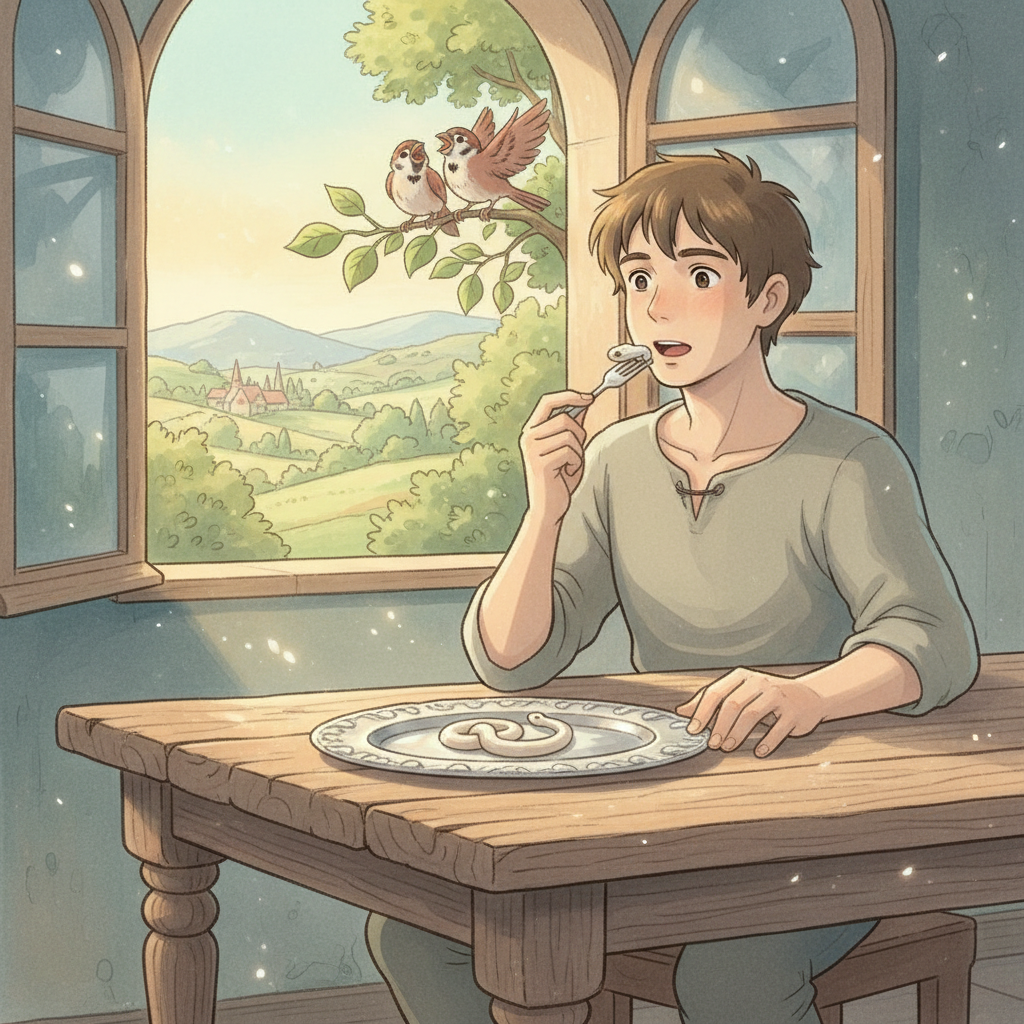
A long time ago, there lived a King who was famed for his wisdom through all the land. Nothing was hidden from him, and it seemed as if news of the most secret things was brought to him through the air.
But he had a strange custom. Every day after dinner, when the table was cleared, and no one else was present, a trusty servant had to bring him one more dish. It was covered and even the servant did not know what was in it. Neither did any one know, for the King never took off the cover to eat of it, until he was quite alone.
This had gone on for a long time, when one day the servant, who took away the dish, was overcome with such curiosity that he could not help carrying the dish into his room. When he had carefully locked the door, he lifted up the cover, and saw a White Snake lying on the dish. But when he saw it, he could not deny himself the pleasure of tasting it, so he cut off a little bit and put it into his mouth.
No sooner had it touched his tongue than he heard a strange 54 whispering of little voices outside his window. He went and listened, and then noticed that it was the sparrows who were chattering together, and telling one another of all kinds of things which they had seen in the fields and woods. Eating the Snake had given him power to understand the language of animals!
Now, it so happened, that on this very day the Queen lost her most beautiful ring, and suspicion of having stolen it fell upon this trusty servant, who was allowed to go everywhere. The King ordered the man to be brought before him, and threatened with angry words that unless he could, before the morrow, point out the thief, he himself should be looked upon as guilty and should be executed. In vain, he declared his innocence. He was dismissed with no better answer.
In his trouble and fear, he went down into the courtyard, and took thought how to help himself out of his trouble. Now some ducks were sitting together quietly by a brook and taking their rest. And, whilst they were making their feathers smooth with their bills, they were having a confidential conversation. The servant stood by and listened.
They were telling one another of all the places where they had been waddling about all the morning, and what good food they had found. And one said in a pitiful tone, “Something lies heavy on my stomach; as I was eating in haste I swallowed a ring which lay under the Queen’s window.”
The servant at once seized her by the neck, carried her to the kitchen, and said to the cook, “Here is a fine duck. Pray kill her.”
“Yes,” said the cook, and weighed her in his hand; “she has 55 spared no trouble to fatten herself, and has been waiting long enough to be roasted.”
So he cut off her head; and as she was being dressed for the spit, the Queen’s ring was found inside her.
The servant could now easily prove his innocence. The King, to make amends for the wrong, allowed him to ask a favor, and promised him the best place in the Court. The servant refused everything, and asked only for a horse and some money for traveling, as he had a mind to see the world and go about a little. When his request was granted, he set out on his way.
One day he came to a pond, where he saw three fishes caught in the reeds and gasping for water. Now, though it is said that fishes are dumb, he heard them lamenting that they must perish so miserably. As he had a kind heart, he got off his horse and put the three prisoners back into the water.
They quivered with delight, put out their heads, and cried to him, “We will remember you, and repay you for saving us!”
He rode on, and after a while it seemed to him that he heard a voice in the sand at his feet. He listened, and heard an Ant-King complain, “Why cannot folk, with their clumsy beasts, keep off our bodies? That stupid horse, with his heavy hoofs, has been treading down my people without mercy!”
So he turned on to a side path and the Ant-King cried out to him, “We will remember you—-one good turn deserves another!”
The path led him into a wood, and there he saw two old ravens standing by their nest, and throwing out their young ones. “Out with you, you idle, good-for-nothing creatures!” 56 cried they; “we cannot find food for you any longer. You are big enough, and can provide for yourselves.”
But the poor young ravens lay upon the ground flapping their wings, and crying, “Oh, what helpless chicks we are! We must shift for ourselves, and yet we cannot fly! What can we do, but lie here and starve?”
So the good young fellow alighted and killed his horse with his sword, and gave it to them for food. Then they came hopping up to it, satisfied their hunger, and cried, “We will remember you—one good turn deserves another!”
And now he had to use his own legs, and when he had walked a long way, he came to a large city. There was a great noise and crowd in the streets, and a man rode up on horseback, crying aloud, “The King’s Daughter wants a husband. But whoever sues for her hand must perform a hard task. If he does not succeed he will forfeit his life.”
Many had already made the attempt, but in vain. Nevertheless, when the youth saw the King’s Daughter he was so overcome by her great beauty, that he forgot all danger, went before the King, and declared himself a suitor.
So he was led out to the sea, and a gold ring was cast into it. Then the King ordered him to fetch this ring up from the bottom of the sea, and added, “If you come up without it, you will be thrown in again and again until you perish amid the waves.”
All the people grieved for the handsome youth; then they went away; leaving him alone by the sea.
He stood on the shore and considered what he should do, when suddenly he saw three fishes come swimming toward him. 57 They were the very fishes whose lives he had saved. The one in the middle held a mussel in its mouth, which it laid on the shore at the youth’s feet. When he had taken it up and opened it, there lay the gold ring in the shell. Full of joy he took it to the King, and expected that he would grant him the promised reward.
But when the proud Princess perceived that he was not her equal in birth, she scorned him, and required him first to perform another task. She went down into the garden and strewed with her own hands ten sacksful of millet-seed on the grass.
Then she said, “To-morrow morning before sunrise these must be picked up, and not a single grain be wanting.”
The youth sat down in the garden and considered how he might perform this task. But he could think of nothing, and there he sat sorrowfully awaiting the break of day, when he should be led to death. But as soon as the first rays of the sun shone into the garden, he saw all the ten sacks standing side by side, quite full, and not a single grain was missing. The Ant-King had come in the night with thousands and thousands of ants, and the grateful creatures had, by great industry, picked up all the millet-seeds and gathered them into the sacks.
Presently, the King’s Daughter herself came down into the garden, and was amazed to see that the young man had done the task she had given him.
But she could not yet conquer her proud heart, and said, “Although he has performed both the tasks, he shall not be my husband, until he has brought me an apple from the Tree of Life.”
58 The youth did not know where the Tree of Life stood, but he set out, and would have gone on forever, as long as his legs would carry him, though he had no hope of finding it. After he had wandered through three kingdoms, he came one evening to a wood, and lay down under a tree to sleep.
But he heard a rustling in the branches, and a Golden Apple fell into his hand. At the same time three ravens flew down to him, perched themselves upon his knee, and said, “We are the three young ravens whom you saved from starving. When we had grown big, and heard that you were seeking the Golden Apple, we flew over the sea to the end of the world, where the Tree of Life stands, and have brought you the apple.”
The youth, full of joy, set out homeward, and took the Golden Apple to the King’s beautiful Daughter, who had now no more excuses left to make. They cut the Apple of Life in two and ate it together; and then her heart became full of love for him, and they lived to a great age in undisturbed happiness.
<center>* * *</center>
Moral of the Story
Acts of kindness, even small ones, will be repaid in unexpected ways, and true worth is not determined by birthright but by character.
Characters

The Servant ★ protagonist
Handsome youth
Attire: Simple tunic and trousers, leather boots, perhaps a belt with a pouch - typical servant attire
Kind, selfless

The King ◆ supporting
Famed for his wisdom
Attire: Royal robes, crown, possibly a scepter
Wise, just

The King's Daughter ⚔ antagonist
Great beauty
Attire: Elegant gown, jewelry, possibly a crown or tiara
Proud, demanding

White Snake ◆ supporting
White scales
Mysterious, magical

The Fishes ◆ supporting
Silver scales
Grateful

The Ant-King ◆ supporting
Tiny ant
Grateful

The Ravens ◆ supporting
Black feathers
Grateful
Locations

King's Private Dining Chamber
A room where the King dines alone, with a covered dish brought by a trusty servant.
Mood: mysterious, secretive
The servant tastes the White Snake and gains the ability to understand animals.

Courtyard Brook
A brook in the courtyard where ducks rest and converse.
Mood: peaceful, revealing
The servant overhears the ducks' conversation and discovers the location of the Queen's ring.

Seashore
A desolate shore where the youth must retrieve the King's ring from the sea.
Mood: desolate, hopeless
The fishes return the ring, fulfilling their promise to repay the youth's kindness.

Princess's Garden
A garden where the Princess scatters millet seeds on the grass.
Mood: impossible, daunting
The ants gather the millet seeds, completing the impossible task.

End of the World Wood
A wood at the end of the world where the Tree of Life stands.
Mood: remote, magical
The ravens bring the Golden Apple to the youth.
Story DNA
Moral
Acts of kindness, even small ones, will be repaid in unexpected ways, and true worth is not determined by birthright but by character.
Plot Summary
A King's servant secretly tastes a White Snake, gaining the ability to understand animals. This new power helps him clear his name when falsely accused of theft. He then embarks on a journey, performing three acts of kindness for various animals. Arriving in a new kingdom, he falls for a proud princess who sets him three impossible tasks to win her hand. With the help of the grateful animals, he completes each task, culminating in retrieving an apple from the Tree of Life. Upon sharing the magical apple, the princess's heart fills with love, and they marry and live happily ever after.
Themes
Emotional Arc
fear to relief to triumph
Writing Style
Narrative Elements
Cultural Context
Grimm's fairy tales often reflect a pre-industrial, agrarian society with clear social hierarchies and a strong belief in magic and supernatural occurrences.
Plot Beats (15)
- A wise King eats a secret dish daily, a White Snake, in private.
- A curious servant tastes the White Snake and gains the ability to understand animal speech.
- The Queen's ring is lost, and the servant is falsely accused and threatened with execution.
- The servant overhears ducks discussing the ring, finds it inside one, and proves his innocence.
- The King offers the servant a reward, but he asks only for a horse and money to travel the world.
- On his journey, he saves three fish from dying in reeds.
- He diverts his horse to avoid trampling an ant colony, earning the Ant-King's gratitude.
- He sacrifices his horse to feed three starving young ravens.
- He arrives in a city where the King's daughter seeks a husband through a dangerous task: retrieving a gold ring from the bottom of the sea.
- The servant accepts the challenge and, with the help of the grateful fish, retrieves the ring.
- The proud Princess scorns his birth and demands a second task: gathering scattered millet seeds by sunrise.
- The grateful ants gather all the millet seeds for him overnight.
- The Princess, still proud, demands a third task: bringing her an apple from the Tree of Life.
- The grateful ravens fly to the end of the world and bring him the Golden Apple.
- The servant presents the apple; he and the Princess eat it together, and she falls in love with him, leading to their marriage and a long, happy life.


